Showing posts with label virgin islands. Show all posts

Monday, June 19, 2017

1982 (5) – Passage to Bermuda


Bermuda - out in the middle of nowhere!

To go to the beginning of this book, Tropic Moon: Memories, click HERE.

We sailed from the Virgin Islands in mid-May, heading to Bermuda, 960 miles due north.  I was miserably seasick, subsisting on the chocolate/oatmeal cookies I always made before a trip. 

Almost from the first, we had problems with Ulysses, our self-steering wind vane.  Ulysses was throwing off screws from his rudder section.  Ed made repairs on the top part of the rudder by donning life jacket and safety harness, climbing down off the stern, and seating himself on the lower part of the steel framework that encased the self-steering.  The surge of the waves would carry him completely out of the water, and then dunk him up to his chest, while he tried to insert new screws into the rudder.  Ed was unable to see, or reach, the bottom part of the rudder. 

You can see the metal structure Ed was sitting on.  Scary...

After 220 miles, and two days and nights of sailing, part of the small rudder broke off, and we lost our self-steering.  Faced with returning south, or hand steering over 700 more miles to the north, each of us on the wheel a total of twelve hours a day, we decided to head back to the Virgin Islands.  On our return, we anchored at St. John.  Ed improved the design, and rebuilt Ulysses' rudder assembly.  Despite strong misgivings on my part, we headed north again on June 1st.  (I suggested we put Tropic Moon back on land at the Nanny Cay boatyard, and fly home for the season.) 

Land Ho!  Bermuda in the distance.
For the most part, we had good weather on the passage.  We were hove to one night for storms.  We reached Bermuda in eight days.  During that time we stood watches, 24 hours/day, four hours on, and four hours off. Combine that with a constantly moving boat, seasickness, and little sleep - I was more than a little crabby by the time we reached Bermuda. 

Yep, I looked pretty tired!

Sunday, January 22, 2017

1979 (7) - Hurricanes

Hurricane Hole


To go to the beginning of this book, Tropic Moon: Memories, click HERE.

We spent our first hurricane season in the Virgin Islands.  It's a time when people keep a careful ear tuned to the weather reports.  With plenty of warning of a major hurricane making its way across the Atlantic, we left Tortola in the British Virgin Islands to sail to Hurricane Hole on St. John in the U.S. Virgins.  Hurricane Hole, divinely designed with yachts and hurricanes in mind, goes well inland with several small, narrow inlets.  There are no beaches in the inlets.  The deep water goes right up to the shores, which quickly climb into hills covered with cacti, and footed with mangrove trees.  Because of the protection afforded by the bay, the water stays calm; seas and waves are little problem.  Boats need only safeguard themselves against the strong winds, which some people felt were intensified by a funneling effect through the inlets.

We awaited our first hurricane with justifiable nervousness.  Hurricane David, reported on hourly over the radio, was being billed as "the worst hurricane of the century."  Yachts arrived from all the nearby islands.  We estimated over 100 boats sharing the anchorage with us.  On arriving at Hurricane Hole, we followed the example of those who had gotten there before us.  We picked a spot close in to the shore in one of the inlets.  We set out three anchors, as well as a couple of "tree anchors" (commonly known as "lines to shore").  The bay looked like giant spiders had invaded, spinning great white webs, trapping the boats with strands that ran to the shores, and every which way through the water.

There were times when I felt it a rather ominous place, especially when Ed went into shore by dinghy to set our tree anchors, and disappeared into the bushes for what seemed an eternity.  Once he stepped on a spiny sea urchin that imbedded two of its quills into Ed's ankle.  We followed some advice we had heard, and treated it with a home remedy - urine.  Despite dire warnings, his foot didn't swell, and gave him very little pain.  Another time Ed returned to the boat with his back covered with scratches.  I asked him if he had met some wild woman in the bushes.  He attributed the scratches to a run-in with a cactus.

Hurricane David passed 110 miles south of us with winds at the storm center of 150 mph.  We had gales in our area with winds of 70-80 mph.  David was due to be its closest to us at 2:00 a.m. - naturally it would be in the middle of the night - so we stood watches during the night to make sure we didn't drag anchor, or get into any other trouble.  I stayed up till midnight, alternating between two good viewing spots, and eating a bag of Hershey's chocolate kisses to help keep me awake.  Ed got up at midnight and stood watch till 5:30 a.m.

With David moving off to the west, everyone tuned in to the weather station for an 'all clear' - only to learn that Hurricane Frederick was on his way.  We all stayed put, did some visiting between boats, and waited expectantly for our second hurricane in less than two weeks.  Hurricane Frederick did most of its damage as it passed over St. Maarten.  Philipsburg, the capital of St. Maarten, is a long, narrow town of three streets, bordered in front by Great Bay, the principal anchorage, and in the rear by the Great Salt Pond.  During Frederick the two bodies of water merged, flooding out Philipsburg with water, mud and sewage.  The situation was worsened by the fact that the Salt Pond was the local garbage dump with landfill as an aim, and all the garbage moved back into town.

Sunnie, a friend from home in Ann Arbor, who had visited us in Grenada, was living and working on St. Maarten at the time of Frederick.  She later told us how she and a friend, Joanie, abandoned the houseboat where she lived, and moved up to a house in the hills belonging to a fellow named James.  In the middle of the night, at the height of the hurricane, after several Bloody Marys, when the electricity and water had both stopped working, they decided to test the phone lines and called James, who was in Antigua.  The phone connection was excellent (a rare occurrence), they passed out after the call, and James stayed awake the rest of the night worrying about them.

Hurricane Frederick, by the time it reached the Virgins - while it apparently went by right overhead - was a weakening storm that got degraded from "hurricane" to "tropical storm."  It was carrying 65 mph winds.  Balancing the strength and distance of David, with the nearness and lesser strength of Frederick, they both had pretty much the same effect on us.  We had gales with heavy gusting winds, the storms themselves followed by a couple days of torrential rains.

Kalizma (the fancy motor yacht we knew in Grenada), showed up at Hurricane Hole.  Kalizma had to stay out in the larger bay because she took up so much room.  We monitored the doings around the anchorage by listening to our VHF radio.  Kalizma had more trouble with the winds where she was.  She was also having trouble with one of her engines, which she had kept running to avoid putting too much stress on her anchors.  She left after David; we don't know where she was for Frederick.  The only damage we heard about was one boat, Arabelle, who must have broken free.  She was across the bay on the rocks, a total wreck.  She went during David.

When the last of the bad weather had passed, we took a day to dry out before returning to Tortola.  Tropic Moon looked like a floating laundry with carpeting draped over the cockpit table and wheel, foul weather gear swinging from the mizzen boom, and towels and clothing pinned to the safety lines.  It was a relief to be able to open ports and hatches again, and air and dry out the boat after being cooped up for so many days.

Tuesday, January 17, 2017

1979 (5) - St. John

Sunset from Caneel Bay, St. John

To go to the beginning of this book, Tropic Moon: Memories, click HERE.

August 1979
After Ed's parents flew home, we spent a couple months anchored in the same spot in St. Thomas Harbor.  We accomplished quite a bit on the boat, working on the paint, chipping the rusty scuppers, varnishing all the teak on the outside of the boat, replacing the alternator, and doing some "interior decorating" in the form of new carpeting and bedspreads.  They were a peaceful two months, but finally the work was done and we were getting the urge to go sailing.  One day we hauled up a rather murky anchor and headed out of the harbor for the very first sail by ourselves.  It was hard to believe we'd been living on Tropic Moon for eight months and this was the first time we'd sailed her without anyone else aboard!

During the next two weeks, we explored the small island of St. John.  St. John is one of the U.S. Virgins, and most of the island is a national park.  The island was beautiful and wild and very sparsely populated.  Our first anchorage was at Hawksnest Bay.  We had a book picturing the Virgin Island anchorages (courtesy of Tony who missed it when he packed to go home), and I looked up Hawksnest Bay.  I knew that it would be a bad anchorage because, although it was pictured with a big anchor, the bay wasn't discussed in the text of the book.  My other clue as to what it would be like is that Ed had a penchant for picking rolling anchorages, and, sure enough, this was one of them.

View from Leinster Bay, St. John

With the wind holding the boat in one direction and the swell rolling in against our beam, Tropic Moon rocked from side to side.  Things fell off counters.  The remedy (partial at best) was to set both bow and stern anchors and point the bow into the swell.  Then the boat more resembled a rocking horse, rather than a drunken sailor, and I'll take the rocking horse over the sailor any day.  It's a kind of seesaw effect - the ends of the boat move up and down while the center stays stationary, making comfortable places of the galley and saloon, which are amidships.  Sitting out in the cockpit eating dinner was another story - we went up and down, up and down....

Despite the rolling, we stayed for three days at Hawksnest.  It was a spectacular bay, fringed by five sandy beaches.  The water was clear and nice for swimming, and we found some interesting coral for snorkeling.  It was a busy place during the day with people coming by car through the park to the beaches, and boats coming in to anchor.  But, by sunset, all the people would go home and, thanks to the rolling, all the boats except us would leave to find other overnight anchorages.  We'd have the whole beautiful bay to ourselves.  The quiet and the total darkness were in great contrast to St. Thomas where, in the middle of the night, we could still read the clock on the wall by the lights from the city.

View from St. Francis Bay, St. John

When we decided to move again, we simply motored around the corner to the next inlet, Trunk Bay.  This was definitely only a day stop - the rolling was so bad it made Hawksnest Bay look calm by comparison.  Trunk Bay was a popular day stop because it's the sight of an underwater trail - our first experience with this phenomenon.  People snorkel the trail.  There were signposts underwater explaining the different types of coral.  My favorite sign was the one that read, "End of Trail."  There I was, floating facedown in the water.  I looked around because I never actually saw a trail, only a bunch of signposts.  The coral off to the side was impressive.  I spent most of my time off the trail looking at the fish swimming among the coral formations.  Their intense colors, their size, and their faces fascinated me.  Some fish swam right up next to me, but would dart away when I reached out to touch them.  The only species you had to watch out for was a large, white-bellied fish, Genus Tourist.  They tended not to know where they were going, and could bump into you.

We left Trunk Bay to motor around another corner to a very good anchorage at St. Francis Bay.  The trouble with good anchorages is that everyone goes there.  The bay, besides being crowded with sailboats, was invaded by a fleet of noisy powerboats with hordes of people aboard.

Annaberg Sugar Mill, St. John

When we had chartered in the Virgins Islands on Fine Feather, in 1976, we had anchored one night in Leinster Bay on St. John.  We had hiked to the ruins of the Annaberg Sugar Mill.  This time, we found a sign that said we could also get to the mill from our anchorage at St. Francis Bay, by following a 1/4-mile trail that led out to the main road. The sign neglected to mention that once we reached the main road, we would still have to walk a mile uphill before reaching the turnoff for the mill.  After navigating a muddy trail, and gingerly making our way past the cows that were blocking the path, we hit the main road.  We hiked along, eventually passing a tourist bus that was stopped by the side of the road.  The busload of people were standing around, admiring the scenery, and drinking large cold drinks.  I was very tempted to try and bum a drink.  The bus was obviously going to the mill, as that was the only place the road went.

The bus passed us as we were climbing the last hill.  We arrived as the passengers were disembarking, and Ed spotted a fellow who had worked down the hall from him at Ford Motor Company!  I asked which one, but Ed wouldn't tell me because he said he couldn't remember the man's name.  Likely story from an antisocial hermit crab!  I decided I wanted to meet these people.  I knew the man couldn't possibly recognize Ed with his full beard, bushy hair, and tattered shorts.  So we joined the tourists, half-listening to the guide, and carrying on the argument in an undertone.  We walked ahead to the lookout at the top of the hill.  I shed a few tears (ineffectual).  I threatened to go up to each man and ask him if he worked at Ford.  Ed was getting angry, and I was working on a good pout when the group reached our spot.  A woman approached Ed, asking him to take a picture of her and her husband.  When Ed was returning the camera, he asked, "Are you the Lovelace's from Detroit?"  I got to meet them after all.  We had a nice chat through the rest of the tour.  They even took a picture of us.

We stood and waved as everyone climbed back on the bus.  As Ed turned and headed back up to the ruins, the tour guide looked at us, pointed down the hill, and said, "Home is that way."  I gave him a big smile.  I'm sure people wonder about us as we wander around with no vehicle, no group of people, and no guide.  We then had the ruins to ourselves, with the exception of one workman with a shovel, who was cleaning the cow dung off the trails.  Cows obviously have no respect for historic sites.

St. Francis Bay was followed by a few days at Leinster Bay.  Though it was, once again, only a short hop from our last anchorage, we felt like sailing.  We went by way of a circumnavigation of Jost Van Dyke, a large island to the north of St. John.  It was an eight-hour trip, and we anchored in Leinster Bay just before dark.  In two weeks, we had managed to work our way around about a quarter of the small island of St. John.

Sunday, January 15, 2017

1979 (4) - St. Thomas


To go to the beginning of this book, Tropic Moon: Memories, click HERE.

While Tony and Joyce were sorry to see the trip end, I was admittedly overjoyed to reach St. Thomas, and have the chance to settle in one area for an indefinite period of time.  We had planned to have Ed's parents visit sometime during the month of May, and we called them the day after our arrival.  We were more than a little surprised to hear they were holding reservations, and would be down the following day.  What with the suddenness of the trip's end, we hadn't even begun to set the boat to rights.  We spent a frantic day cleaning Tropic Moon, changing beds, washing clothes at the Laundromat, and stocking the boat with food and beverages.  Since Tropic Moon was at anchor, we ferried ourselves back and forth in the fiberglass dinghy.  We had to rely on our rowing skills, since we didn’t have a dinghy engine.

Ed's parents were with us for ten days.  We spent that time cruising the U.S. and British Virgin Islands.  The Virgin Islands are grouped closely together, with short sails from anchorage to anchorage.  After our recent experiences coming up the island chain, it was pleasant to cruise in protected waters around these beautiful islands.  After leaving St. Thomas, we visited Caneel Bay on St. John.  Our anchorages in the British Virgin Islands included Cooper Island, The Baths on Virgin Gorda, Road Harbor at Tortola, and Jost Van Dyke.


Angelina Lauro

When we entered the harbor of Charlotte Amalie, it would have been hard to miss the burned out hulk of a cruise ship near the main wharf.  We learned the ship was the Angelina Lauro.  On March 30th, the ship was berthed in St. Thomas when a fire broke out in her aft galley.  It spread rapidly.  The crew wasn’t able to contain the fire, and soon flames roared high from her top decks.  The vast majority of her passengers and crew were ashore when the fire broke out.  All those still on board managed to disembark safely.

Most of the ships in port were on the final day of their seven day Caribbean cruise, having started from San Juan. As a result, passengers from the Angelina Lauro were divided into groups between the various ships in port, and were taken aboard for an overnight voyage back to San Juan.  Most of Angelina’s passengers had been ashore in shorts and tops, and had lost all their belongings in the fire.  The Sun Princess took 400 of Angelina’s passengers, and provided them with a buffet dinner, and a continental breakfast the next morning before they disembarked in San Juan.  From Puerto Rico, they were flown home to the States.

The Angelina Lauro was declared a total loss.  She remained dockside for months. A number of attempts were made to tow her away from the wharf.  These failed, mostly due to the massive weight of the water that had been pumped into the ship to douse the fire.  She ended up sitting on the shallow bottom, listing to port.
 
The anchorage at Charlotte Amalie, St. Thomas

June 4, 1979

We are comfortably settled in St. Thomas.  We’re anchored off the Sheraton Marina.  I spoke with someone in the office.  They’ll be happy to receive mail for us, even though we’re not docked at the marina.  They’ll hold the mail for three months, in case we go off for a while.  The Sheraton shows movies on Sunday nights.  A week ago we saw ‘The Adventurers,’ with Ernest Borgnine and Candice Bergen.  It was funny to watch.  The movie was made for a wide screen.  The hotel showed it on a home movie screen.  All the people were tall and skinny, and the cars looked like they belonged in cartoons.  We went in again last night, but they ended up not showing a movie, thanks to a power outage on the island.  People were hanging out of the hotel windows because there wasn’t any air conditioning.  Anyway, it wasn’t a wasted trip since we had dinner at McDonald’s, where, for some reason, they still had power.

We invested in a new alternator.  Ours kept overheating; it smelled like we were burning down the boat!  Ed spent hours working on it.  He had to make a new bracketing system, since the new alternator is a different size from the old one.

Some barges arrived from Sweden to start work on the Angelina Lauro.  We can’t tell what, if any, progress is being made.

June 11, 1979

Charlie’s Angels and the Love Boat are going to be filming a joint two-hour episode here on St. Thomas!  Part of the show will be filmed in town, and part will be filmed on the Pacific Princess, a cruise ship that stops at St. Thomas.  This cruise ship is a sister ship to the Sun Princess I went on in Grenada.  The other day, when we were taking care of the boat registration at the Commerce Department, I saw a sign saying they were auditioning for extras for Charlie’s Angels.  I went in and applied.  I doubt I’ll be called – I said I just wanted to be a body in the background.  They’ll be filming the end of this week.  Maybe we’ll see an “Angel.”

We had a bad storm on Saturday that lasted about half an hour.  The winds were unbelievable.  We were glad we had two anchors out.  We held our ground, though several boats didn’t.  Two boats not far from us started banging into each other.  There wasn’t anyone on either of them.  We saw a boat drag, running into another boat.  One sailboat broke a spreader off the mast, trying to get untangled.  Several boats pulled up anchor and motored out of the harbor to get out of the way.  Scary!

St. Thomas Harbor anchorage

June 26, 1979

Well, I didn’t get called for Charlie’s Angels, but I talked to a lady who did get called.  She’s an older woman whose husband runs the electronics shop at the marina.  She was hired to be a passenger on the cruise ship.  She was told to dress elegantly, and wear high heels.  She would be filmed walking down the gangplank.  She said she walked up and down that gangplank for 2-1/2 hours!  She got to meet the Angels.  It’s possible Tropic Moon may be in the show.  We saw a helicopter flying around the harbor, filming. 

More tugs and barges with large cranes have arrived from Sweden to work on Angelina Lauro.  They pulled up her anchor a couple days ago.  They were working late last night, with big spotlights shining on the ship.  Ed heard on the radio that she’s to be re-floated, and then towed to Taiwan to be cut up for salvage.

I got Ed off the boat Sunday night to go to Pizza Hut.  It was the first time he’d been to shore in a week.  I’ve gone in three times for laundry and grocery shopping.  The wind has been strong, making rowing to shore difficult.  It discourages me from going in without a good reason.  Rowing back to the boat is much easier.  One day I took the dinghy in to shore to scrape the bottom.  Lots of seaweed and stuff was growing there.  Sometimes I feel like I’m living in a parallel universe.  While I was working on the dinghy, a man came by – with a horse – and they both went swimming.


July 8, 1979

My sewing machine is now operational.  Ed installed the converter that changes the boat’s 12 volts into 120 volts.  We just plug the cord into this box, and flip a switch.  Besides the sewing machine, it’s also been used for the soldering iron and the electric drill.  In Grenada we had shore power, which isn’t an option when you’re anchored.  We’re going to be making sail covers as soon as we get organized.  We’re buying new carpeting for the forward and aft cabins.  It’s fun to do small decorating projects.  I want to hang a needlepoint picture I had brought down from the States.  I have to figure out a way to secure it to the bulkhead so it stays in place when we sail.  The problems of having a movable home!

Progress continues on the Angelina Lauro.  She is almost erect now; they're still pumping water out of her.  The radio informs us a tug will be coming for her on July 11th.  Then the tug will be picking up another wreck in Venezuela that is also being towed to Taiwan for scrap.  That should be some funny-looking trio, crossing the Pacific Ocean.
 
Me, in one of the shopping alleys in Charlotte Amalie

July 20, 1979

I thought we were ready to leave St. Thomas, but Tuesday we heard Tropical Storm Claudette was on her way.  We set out two more anchors and waited.  Almost nothing happened here, except for rough waters in the harbor.  It rained most of Wednesday.  Well, that’s three down – Ana, Bob, and Claudette.  So far, no problems for us.

Before we leave Charlotte Amalie, we have to go in to the marina dock to fill up with fuel and water.  That makes me a little nervous.  It will be the first time we go in to a dock by ourselves.  This reminds me of when we left Grenada.  Ed was at the wheel, Joyce was on board, and Tony and I were on the dock, casting off the lines.  Ed called us to get on the boat.  Tony did, but I froze.  Tropic Moon got about four feet from the dock.  I would have had to jump, catch onto the boat, and pull myself aboard.  I didn’t have the nerve to try.  Ed was pretty pissed.  He had to drive back into the boat slip to pick me up.  Stumpy came over from his boat.  He held the bow, and helped me climb aboard.  It was rather embarrassing. 

Postcard


Friday, January 13, 2017

1979 (3) - First Cruise

Our first cruise took us from Grenada, north to the U.S. Virgin Islands
To go to the beginning of this book, Tropic Moon: Memories, click HERE.

Grenada, April 13, 1979

Tony and Joyce were due yesterday, but called a couple days ago to say they will arrive Monday, the 16th.  We were pleased, because we can use the extra couple days to finish a million odds and ends, and maybe to relax a little.  Ed’s working on equipment like the depth sounder, and getting the radio hooked up.  Hopefully, we will leave here on the 18th.  I was so tired last night.  After we had some crackers and cheese, with Pina Coladas, I passed out about 7:00 p.m. and slept for twelve hours.

Tuesday was Sam’s last day, as all the big jobs are done.  We gave him the propane stove we had removed from the boat.  It was both a going-away present and to thank him for his help.  We also gave him Ed’s wooden trunk, which had been traveling around with Ed for thirteen years.  Wonder where it might travel to now? 

We have our VHF radio hooked up, and it works fine.  We’ve used it to speak to a few people.  The life raft is stowed on the aft deck, the sails are in the peak, and I’m anxious to get going!!  I’ll try to mail postcards while we’re traveling.  The EC money is used through most of the Caribbean, but we’ll have to get stamps at each island, as they’re all different countries.  When we get to the Virgin Islands, we’ll be back to American dollars.

Postcard, Grenada, April 18, 1979

Tony and Joyce arrived on Monday.  We went for a sail yesterday, then anchored at the beach and went swimming.  Today we will do our last food shopping, and probably leave Grenada tomorrow.  Tropic Moon sailed well, and is looking really good!  Tony cooked a delicious eggplant casserole for dinner last night, and is talking about eggs and hash browns for breakfast this morning.

Newsletter, May 17, 1979

We made our first adjustment from the work-a-day world to a work-on-the-boat life, and after 5-1/2 months in Grenada, we were more than ready to make a further welcome adjustment to the cruising lifestyle.  The whole concept of "cruising" was new to us.  For example, we had little idea of how long it took to travel from island to island, or, more importantly, that when we reached a new anchorage, we wouldn't be overly eager to rush on to the next one.  Combine that with a preconceived notion that we wanted to spend the summer in the Virgin Islands and you have our rationale for racing through the Caribbean in three weeks.  We had contacted friends from Ann Arbor, Tony and Joyce, invited them to fly to Grenada, and told them that we'd drop them off in St. Thomas in time to fly home at the end of their three weeks of vacation.

We started the trip, which was to cover 650 miles, fairly leisurely.  We left Grenada on April 19th and spent our first night at the island of Carriacou, just north of Grenada.  From there we sailed to Union Island to clear Customs to enter the Grenadines, a 50-mile-long chain of small, lovely islands.  We spent a night at Palm Island, and then sailed into the Tobago Cays.  The Tobago Cays are really beautiful.  They're a group of uninhabited islands with lots of reefs and white sandy beaches.  There were a few other yachts there, but as there are several areas in which to anchor, it was far from crowded.  We enjoyed the swimming and snorkeling in the area.

By chance, we anchored next to a boat, Aquarian Mistress, that we had met in Grenada.  We invited Tony and Paula over for drinks and dinner.  Our Tony was chef for the evening, and he fixed fried rice using a couple of conchs which Tony and Paula had caught.  Conch proved to be a lot of work to prepare.  First, the fellows broke open the shells and wrestled out the conch, which was still alive.  Then they cut off its eyes and legs and any other protruding parts.  Next they beat it to death, using a hammer.  If the conch isn't pounded well, it chews like shoe leather.  And after you've tortured the poor mollusk, you have a piece of meat with very little flavor.  On its own, not worth the bother, but useful in dishes like chowder or fritters.

After a couple nights in the Tobago Cays, both boats were ready to sail on to Bequia, one of the larger islands of the Grenadines.  We decided to sail in company with Aquarian Mistress.  The boats were very well matched in terms of speed, arriving in Bequia at virtually the same time, after a 7-hour sail.  There are two major bays on Bequia, Friendship Bay and Admiralty Bay.  After failing to consult the cruising book carefully enough, we mistakenly chose to go to Friendship Bay.  The town, stores and restaurants were all on the other side of the island.  As it was too late to go around the island, we stayed in Friendship Bay for the night.  It was an uncomfortable, rolling anchorage, so we decided to move nearer to the shore, where we set two anchors (bow and stern).  No one measured the depth of the water, and we soon found ourselves hitting bottom.  Things got worse as we tried to correct the situation, but we finally got ourselves free again.  It was after dark, and rather scary.  Less than a week out, and already aground!

We met another boat, Osprey, in Friendship Bay.  The family was also from Ann Arbor.  Osprey had just completed a 2-1/2 year circumnavigation.  One other boat came into the bay that night, a charter boat with charterers from Ann Arbor.  Of the four boats anchored there that night, Ann Arbor was represented on three of them.

We had a couple hours of sailing the next day to get around Bequia to Admiralty Bay where we spent the next three days.  The town is small, but looked good to us, as it was a chance to restock fresh food.  Small boats with young boys came out to the yachts with things to sell.  Joyce bought a pretty piece of coral from one boat.  One "vegetable" boat sold me fresh eggplant and tomatoes.  They also offered laundry services, which we declined; such services usually end up costing a small fortune.

We woke up in Bequia one morning to find everything inside and outside the boat covered with ash from the St. Vincent volcano, which had erupted during the night.  I hated to think of what it was like on St. Vincent, as we were about twenty miles south of the volcano.  What a mess!  First, we swept up the ash, then reversed the bilge pump, connected a hose, and washed down the boat.  All the other yachts in the harbor were busy with the same type of activity.

By the end of our stay in Bequia, 1-1/2 weeks of our 3-week total had evaporated into the tropical air.  Knowing we would have to bypass many of the islands, and having Martinique on our "must see" list, we left Bequia and the Grenadines to sail to Martinique on what would be our first overnight sail.  Leaving Bequia at about four in the afternoon, we arrived in Martinique about noon the next day.  My first overnight sail terrified me.  I got a bit hysterical when we ran out of wind, and Ed refused to turn on the engine.  I found it frightening to be "out there" in the dark.  Still, the trip went well, and we even arrived at the time Ed had estimated.

We reached Martinique on a Friday and stayed till the following Tuesday.  We anchored at Fort de France, a very cosmopolitan city be Caribbean standards.  Only French is spoken on Martinique, and I had fun with my feeble efforts.  Tony and Joyce also know some French so we managed fine.  We ate dinner out twice, my favorite being a place where I had cheese fondue.  My dessert consisted of two large crepes filled with ice cream, smothered in a chocolate and almond sauce, and topped with fresh whipped cream. 

The last leg of our trip was direct from Martinique to St. Thomas.  We left Fort de France on a Tuesday evening and didn't reach St. Thomas till Saturday morning.  We were out of sight of land the whole time.  We worked on watches 24 hours/day, four hours on, four hours off.  Ed and I stood watches together, as did Tony and Joyce. 

Three and a half days out.  You picture a sailboat zipping along through the water.  Only for the first day, and then we ran out of wind - becalmed!  Now you picture a boat sitting still in the water.  Not really!  Becalmed is one of the worst misnomers I've ever run into, as the situation is anything but calm.  When there's no wind, there's usually still a sea, which tosses the boat from side to side, and sometimes pitches it in what seems like all directions at once.  It was impossible to move through the boat without hanging on.  And the noise!  Hoping for a breeze, through lack of experience, we left the sails up without sheeting in the booms.  The booms crashed back and forth, halyards slapped, blocks were jarred up and down, banging on the deck.  Things were knocking around inside the boat, and the noise and movement just didn't stop.  And on top of it all, we weren't going anywhere!

I think those early sails set a pattern for how I would feel about future passages.  I was tired, sick, and frightened.  I found the passage long, boring and totally exhausting.  I seemed to be the only one who felt that way - the other three were enjoying themselves.  I, on the other hand, was suffering from feelings of claustrophobia.  I found that being out on a sailboat far from land, especially when you're not making any progress, and YOU CAN'T GET OFF, made me panic and feel trapped.  Ed thought I was nuts.  Luckily, I was asleep through much of the trip - off and on watch - I actually fell asleep once standing at the wheel.  I usually managed to avoid thinking too much about where I was and what I was doing. 

Ah, you say, but the wind finally came back, and all was well.  No, the wind didn't come back.  After sitting in one spot for a day, Ed finally relented, turned on the engine, and we motored over 100 miles.  We found a little wind again up near the Virgins.

One of my memories of the trip concerns the apricot pie filling.  The can had been opened at dinner, but not used, and the filling was stored in a plastic bowl with tight-fitting lid, on a counter (with rail), in the galley - a place that had been a good stowage spot up till that point.  It was 1:00 a.m.; Ed and I had gone off watch at midnight.  We were asleep when the wind died.  I woke to hear something flying across the galley.  We got up to find apricot goo spread through the hall, and into the head, where the floor is made of wooden slats - through which the filling had oozed.  It was just about impossible to clean up, partly because it was so sticky, and partly because Tropic Moon was lurching from side to side.  We cleaned up what we could, but didn't take up the head floor till we were in port again, at which time Ed had to use a putty knife to chip off the remaining dried-up filling.  During the clean up, I was in the galley when the gingerbread, in its corning ware baking dish, took off across the room.  I managed to catch it as it passed over the sink.

Ed and I were on the "dawn watch" and a little after daylight one morning about twenty dolphins joined Tropic Moon and stayed with us, frolicking around, for about five minutes.  That was a joyful sight.  The next morning, dawn watch again, a large fin passed right by the boat.  It was a whale, traveling with some friends.  I guess it had come in close to take a look at us.  Ed estimated it at about twenty feet long.  And lastly, on one of our night watches, I had just given the wheel back to Ed, and was settling down in the cockpit, when something went "flap" and landed in my lap.  I accused Ed of throwing something at me.  He was laughing, and said it was a flying fish.  I was madly trying to get it out of my foul weather jacket, where it was jumping around.  It was about six inches long.  I saved it to show our friends when they came on watch.

Tony and Joyce enjoyed the trip, and hated to see it end.  Entering the large port of Charlotte Amalie on St. Thomas was a bittersweet experience for them.  We had arrived in St. Thomas on a Saturday morning, and their plane was scheduled to leave at 1:00 that afternoon!  Goodbyes were hurried as our three weeks together ended.


Tuesday, January 3, 2017

1976 - Sailing on Fine Feather and Antares

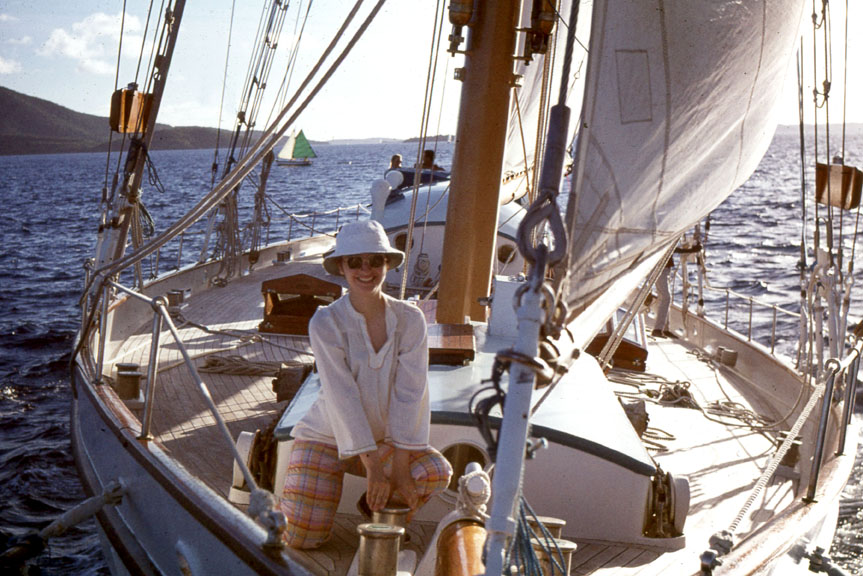
Deadly serious...  My first time at the helm of any boat.
Captain John keeping an eye on things.
Yacht Fine Feather, U.S. Virgin Islands

Ed brought his sextant on Fine Feather, to practice taking sun sights.
Here he is, calculating our position.  Of course, I could have told him
where we were.  That's Peter Island in the background.
Antares, a 90 ft. schooner from South Africa.  While staying on Fine Feather, the crew took us for a day sail on Antares.

Ed sitting out on the bowsprit (Virgin Islands)

Looking forward along the deck

Me, sitting with a young crew member

I wasn't going out on the bowsprit, so I passed the camera to Ed to get this picture


Monday, June 8, 2009

Black and White


I'm nuts about color, but sometimes the simplicity of black and white makes a pleasant change. Here's a sampling of six photographs that I've worked with in Photoshop, removing the color, and using a variety of filters on some of them. The image above is from a photograph I took on one of my walks. (Morehead City, North Carolina)

Shrimp trawlers at a dock in Beaufort, North Carolina. One of my friends wants me to put a wreath on the bow of the front boat and make Christmas cards for her. That would be fun!

A rocker on a front porch in Beaufort, North Carolina.

Bottom side of a fishing pier, Atlantic Beach, North Carolina.

A beach on Peter Island in the U.S. Virgin Islands. I was playing with texture filters, and also a technique for adding the cool black border.

This last is my favorite shot of a magnolia blossom from this spring's pictures. (my back yard, Morehead City, North Carolina)