Tuesday, January 31, 2017

1979 (11) - Passage to Antigua

Charlestown, Nevis

To go to the beginning of this book, Tropic Moon: Memories, click HERE.

After we had filled up on fuel and water, deciding it was too late to leave for Antigua, we anchored in the bay about 4:00 p.m.  But Ed stayed up by the bow, gazing seaward, and I knew he wanted to leave.  (You should never start a long sail when you're already tired.)  Ed claimed we would reach Antigua, which is about 100 miles S-SE of St. Maarten, by noon the next day.  Ed hauled up the anchor again and we left. 

That night we hit rough seas and strong winds.  I kept vomiting and couldn't keep anything down, even water.  We were over-canvassed, but I doubt we realized it at the time, through lack of experience.  The lee rail was often in the water.  We had our genoa up, and during the night the metal strip to which the genoa's sheet block is attached ripped off, leaving the sail flapping wildly.  Ed had to go forward on deck to do temporary repairs.  It was difficult to do any work and hang on at the same time, as the motion of the boat was violent. 

When dawn came we had hoped to be able to spot Antigua, but a study of the chart showed that we were still over fifty miles away.  With winds from an unfavorable direction, we knew we wouldn't make it by nightfall.  In the early morning we were hit by a squall.  After the squall Ed went forward, changed the genoa for our smaller jib, and reefed down the mainsail.  I suppose there’s always some compensation; the most beautiful rainbow I have ever seen followed the squall.  It reminded me of what young kids produce when they’re told to draw a picture of a rainbow.  They might take their crayons and draw an arc from one side of the paper to the other, putting in each stripe of color, and having the rainbow dominate the picture.  I imagine a teacher would say "nice rainbow," but think rainbows don't really look like that.  Well, we saw one, and it was huge, arching through the sky with both legs in the water.  Each stripe of color distinct from its neighbor.  We just sat and stared at it until it faded away.

Rainbow

Off to the west and downwind of us was the island of Nevis.  We decided to put in there for the night.  Ed went down below to read the chart, and came back up to say that Nevis was fifteen miles away, and we could be in by early afternoon.  It turned out Ed misread the chart.  It was two miles/inch rather than one mile/inch.  We also had to go around to the lee side of the island to reach the port of Charlestown.  Instead of fifteen miles, it became fifty.  With the help of the engine, we just made it in at sunset. 

The seas by Nevis were unsettled, and the boat had to be steered carefully so that each wave could be taken at a slight angle.  While I was at the wheel, one wave hit us on the beam, and splashed over the boat with such force, I was knocked off from the wheel, and fell into the cockpit.  It was the one time on the trip I hadn't hooked on my safety harness, and I was quick to relatch it.  So many waves hit the boat; we were drenched, and coated with salt.  Ed's eyebrows were white with an accumulated salt crust.

Nevis, while offering up rough seas off its windward coast, captured our attention with its beauty.  Nevis is a volcanic island; the extinct volcano, with its head in the clouds, dominates the landscape.  We were motor sailing around the southern part of the island, which appeared uninhabited, and was really beautiful with its green fields, deserted sugar mills, and rough coastline dominated by the volcano in the background. 

The results of our being knocked about were evident below deck, especially in the forward cabin, where almost everything had gotten loose, most ending up on the floor.  Before leaving St. Maarten, I had purchased some postage stamps representing several of the islands, and had pasted them on sheets of writing paper.  I put these sheets on my clipboard, underneath more writing paper and envelopes, and placed the clipboard with several other items on a shelf over the head of my bunk.  It was difficult getting into the forward cabin.  The hook holding the door open had let go, and the door had slammed shut.  A pair of scissors, which had fallen from one of the shelves, was jammed under the doorframe.  I found one of the pages of stamps on the floor, looking like someone had taken it in his hands, and crumpled it into a ball.  My Snoopy was on top of a heap on the floor, and I thought I heard him muttering something about jumping ship at the next port.

The most unpleasant surprise was discovering our fresh water tanks had been contaminated with salt water.  There’s an inverted U-shaped pipe underneath the starboard rail, which acts as an air vent to our water tanks.  Our starboard rail had been underwater for long enough that salt water had siphoned into the tanks.  And that, in case you didn't get the implication, was our drinking water.  We carry a 5-gallon plastic jerry can in the cockpit with extra water, but the jerry can had fallen over during the trip, cracked, and all the water had leaked out.  We went from about 125 gallons of fresh water to zero gallons awfully fast.  As we had just filled the tanks in St. Maarten, we had that much water to hand pump out of the tanks before we could refill them in Antigua.  The water in the tanks was still potable, though quite brackish.  For five days we drank Coca Cola and grapefruit juice.

We stayed at Nevis for two days, and then took a day to sail south to Montserrat.  We moored overnight in a deserted bay near the northern tip of the island.  The following day we again headed windward toward Antigua, and at the end of a very long day, put in at Curtain Bluff Bay on Antigua's southern coast.  The following morning we motored east for three hours to reach English Harbour, our destination on Antigua.  And, what had started out as a "we'll get there by noon tomorrow" trip, ended up being a weeklong journey instead.


Sunday, January 29, 2017

1979 (10) - St. Maarten - Part 2

Me, in St. Maarten.  I was wearing my Bitter End Yacht Club t-shirt.

To go to the beginning of this book, Tropic Moon: Memories, click HERE.

Hanging around St. Maarten started to get old.  When Sunnie offered me a temporary job, I went to work for International Supply.  The company is a huge auto parts store, similar to the Western Auto’s back home.  A frantic sales counter served customers who stood around holding mufflers, tail pipes, and the like.  It was the only place in the Caribbean I’d seen that actually bustled.  

My first assignment was putting together their six-month paint order.  I also set up a cross reference system of part numbers for different manufacturers of exhaust systems, labeled stock, wrote up orders, and performed other tasks that were reminiscent of my library days.  As I was out of practice at working, I made it through five days, then took a three-day weekend, worked two more days, and haven’t been back for almost a week.  International Supply is starting five days of inventory, and I’m sure I can make myself useful updating their card system.  I got $30/day, and an employee discount at International Supply.

Mermaid of Carriacou

While waiting in St. Maarten, we took a three-day trip to sail to St. Barts, a French island about twelve miles south of St. Maarten.  Thanks to the prevailing winds, it was six hours over - and three hours back.  Our little trip gave us the opportunity to practice leaving and entering a harbor under sail, a good thing to know when your engine is less than reliable.  We did fine, which means we didn't run into any other boats.  While in St. Barts, we visited the stores and finished our Christmas shopping.  We had heard that the people there speak English, but the truth was, they spoke English about as well as I spoke French - vaguely.  I conducted the whole transaction in a bakery in French, which may sound good, but we ended up with turnovers stuffed with vegetables, instead of fruit.  It never occurred to me to ask what was inside of them. 

Post card from St. Barts

The engine parts never did arrive from England and, after a month, we finally gave up on them.  We left Sunnie's address with the post office in case the parts showed up.  We also cabled England again, asking them to initiate a trace, and to send replacements to Ed's parents' address in New York.  By that point, we had spent $100 on a $10 part, and still had nothing to show for it.  Sometimes things go that way.  We had made airline reservations to fly Stateside for the holidays, leaving Antigua on December 17th.  With only two weeks left to reach Antigua, and make arrangements for securing the boat, we figured that it was time to be on our way.

Church in St. Maarten

The day we planned to leave St. Maarten, we motored into Bobby's Marina for fuel and water.  We had a little trouble going in, as we had to drop an anchor off our bow, and back up between two other boats, to tie our stern to the dock.  Tropic Moon has a thing about going backwards - she won't if she can avoid it.  The wind was from astern, and we were trying to fend off from the two neighboring boats, which happened to be unoccupied.  A fellow came along the dock and caught our stern line to tie us off.  The docking rope slipped out of the cleat, came up against the wooden support for the dinghy engine, and started ripping off the wooden post.  We had Tropic Moon pulling one way, and this fellow on the dock pulling the other way. 

Ed reached in to grab the rope to put it back in the cleat.  In doing so, he managed to cut his finger open on a screw.  We got Tropic Moon secured, and Ed went below before I saw what had happened.  He bled all over cushion, deck and cockpit, and down below he sprayed the head with blood - it was on the toilet, sink, walls and mirror.  We did a little tourniquet on his finger, and used a Band-Aid to tape the ends together, which had received a long L-shaped cut.  The only way I can describe how bad the cut was, is to say that Ed almost went to the hospital for stitches (he has no use for doctors or hospitals), but then changed his mind.  I should have gone in for a sedative.  We filled up on fuel and water, rested awhile, and decided it was too late to leave for Antigua.  At 4:00 p.m., we reanchored in the bay.
Hibiscus


Friday, January 27, 2017

1979 (9) - St. Maarten

Anchorage at Philipsburg, St. Maarten

To go to the beginning of this book, Tropic Moon: Memories, click HERE.

We left Virgin Gorda October 11th, at 7:00 a.m., and arrived in St. Maarten the next night at 9:00 p.m. - after 38 long hours of sailing.  St. Maarten is 80 miles to the east of Virgin Gorda and, as there's generally a steady wind out of the east, it’s impossible to sail in anything resembling a direct path.  We had strong winds and were able to travel at 5-6 knots the whole way.  But, with all the tacking we did, we actually sailed 200 miles to cover the 80 miles distance between the two islands.  It took far longer than expected, as we had planned on arriving in daylight.  Rather than spend another night at sea, we decided to try entering the harbor in the dark. 

Through the afternoon, as we made our slow progress toward the island, we compared the coastal features with the chart and picked out what appeared to be Philipsburg, the capital, and a port of entry.  I still wasn't overly confident that we'd even found St. Maarten.  I mean, how does one really know?  They don't put up signs or anything.  (Note:  This was way before GPS, and we didn’t have satellite navigation.  Our navigation tools consisted of a sextant, for sun sights, the compass, and the knot meter.)  When darkness fell, we could see a flashing light that verified our position.  Once near land, we dropped the sails and motored into the bay.  We couldn't make out any anchorage, as it was very dark, so when we were past the mouth of the harbor, we just dropped the anchor right there, left our stern light on, and collapsed into bed.  The next morning we raised the anchor and motored over to the other yachts to join the flock.

When we left Road Town for Virgin Gorda, after not sailing for a month, I felt that everything I had learned came together.  I had more confidence in what I was doing.  When we left Virgin Gorda to sail to St. Maarten, rather than staying at the wheel as usual, I went forward to attach halyards and jib sheets.  I raised the sails myself for the first time.  And, although we were alone on this 38-hour sail, I felt things went well, and I held up my end of the watches.  That is, until Friday morning, when we sighted St. Maarten about 25 miles away, dead into the wind.  We were making very little progress in the right direction.  I wanted to start the engine, and motor straight in, rather than face another day, and possibly another night, at sea.  The captain (a sailing purist), refused to discuss the matter.  I was furious, resigning my crew position.  I told the captain he could sail his own f***ing boat, and went below for several hours.  I made up for it later by coming on the wheel at 2:30 in the afternoon, and staying on till 9:00 when we finally anchored the boat.

L'Escargot, a restaurant in Philipsburg

October 20, 1979
St. Maarten, part of the Kingdom of the Netherlands, is a country on the southern part of a Caribbean island shared with Saint Martin, a French overseas collectivity. Its natural features span lagoons, beaches and salt pans. The capital, Philipsburg, has cobblestone streets and colorful, colonial-style buildings lining the Front Street shopping area. The port is a popular cruise-ship stop.

Sunnie (our friend from Ann Arbor, who had visited us in Grenada), worked for International Supply on St. Maarten.  Our mail was being sent to International Supply, and we were anxious to collect it.  On Monday, we tried to call IS from the phone company, but couldn’t get through.  Learning that IS was only a mile away, we walked over, where we found that Sunnie was on Antigua.  We were told she’d be back on Wednesday.  Since the phones still weren’t working, we walked over a second time.  We learned that when Sunnie flew in that morning, she hadn’t had picture ID with her landing papers.  She got kicked off the island!  She had to get on another plane, and fly back to Antigua.  While we were in the office, the phone rang.  We heard Bob say, “Hi, Sunnie, just a minute.”  Bob handed the phone to me, and I gave Sunnie quite a surprise.  (International calls were going through, but not local ones.  Go figure.)  Sunnie finally made it back to St. Maarten on Friday.

The Hustler, Arawak Motors, Antigua

After Sunnie straightened things out with immigration, she planned to go back to Antigua for another month.  Bob, who owned International Supply, had several companies on St. Maarten and Antigua, including Arawak, on Antigua.  Arawak is an automobile manufacturing company that makes the Hustler, a car with a fiberglass body.  Sunnie was managing the car company.  Arawak was turning out two cars a week, and wanted to increase production to six-ten cars per week.  Sunnie told us there was a big market for the Hustler in the Caribbean.  The car was good at climbing mountains and crossing rough terrain.  The car rental agencies in the islands liked to buy them. 

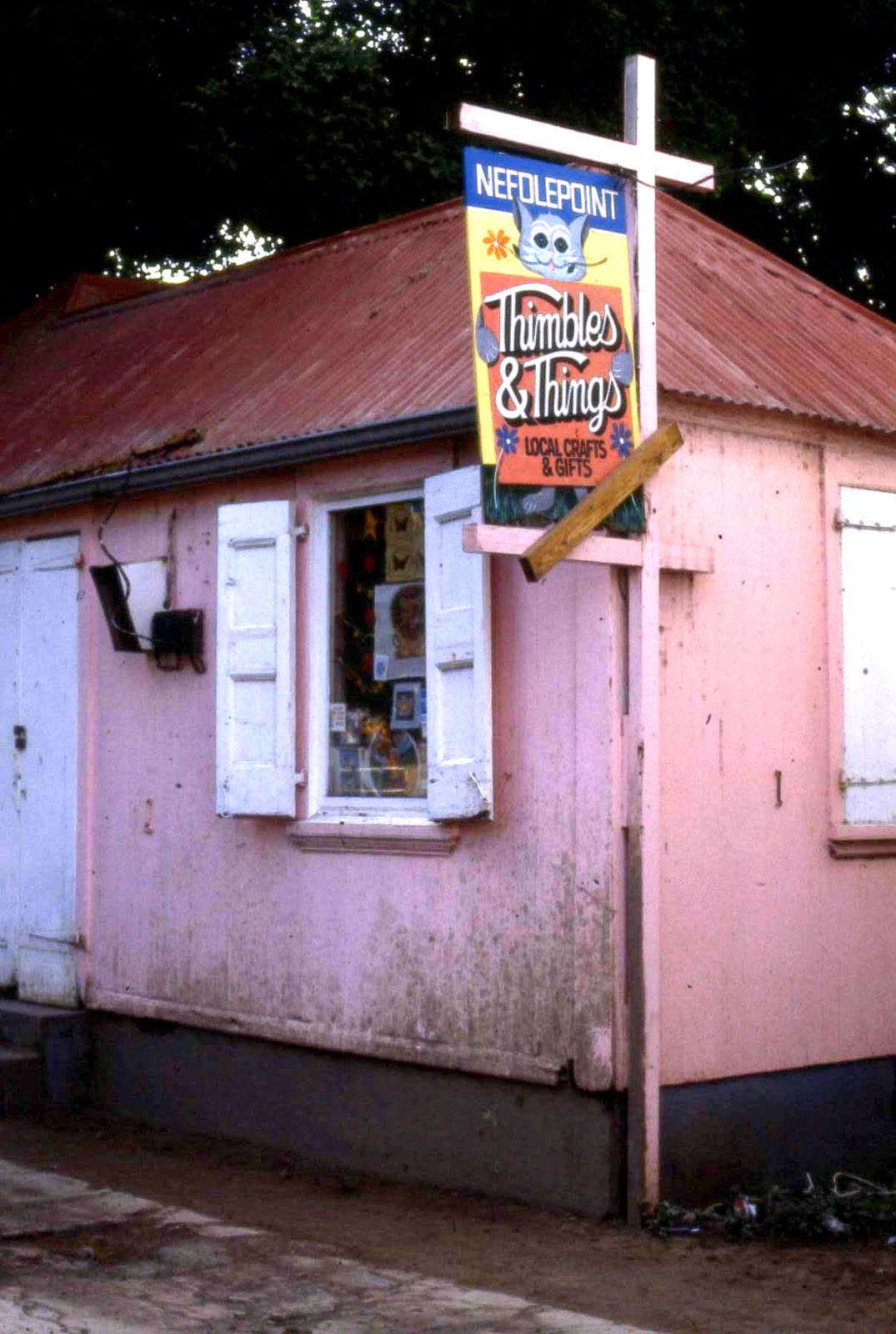
St. Maarten is a duty free port, with lots of nice shops.  We spent most of a day wandering through the stores.  My favorite was Thimbles & Things, which had imported needlepoint canvases from all over the world.  We were surprised to learn that Thimbles & Things is one of the companies Bob owns.

Thimbles & Things, Philipsburg, St. Maarten

October 29, 1979
The week after we arrived at St. Maarten, we took Sunnie and two of her friends, James and Joanie, out sailing.  James runs the fiberglass part of the auto company, and Joanie manages Thimbles & Things.  There was almost no wind for sailing.  After three hours, we weren’t very far out of the harbor.  We ended up going to the next bay, and anchoring there to go swimming.  I had fixed a lunch of Gazpacho, with cheese and rolls.  Sunnie brought a case of Heineken and a cooler of ice.

It was one of those classic situations where we had to be back by a certain time because James had a plane to catch.  Ed said, don't worry; we'll just start the engine and motor back.  Though the starter motor was sounding a little sick, the engine did get going, and we returned to Philipsburg on time.  I still haven't figured out why it worked when we needed it, because that was the last time the engine started.

Ed tried the engine again in the evening, and nothing happened except a click.  He took the starter motor apart and found myriad problems - rusted-out brushes, a broken tooth on the pinion gear, disintegrated insulation and insulating tape.  We weren’t able to find the parts we needed on St. Maarten.  Bob checked when he flew to Antigua, even visiting junkyards, with no luck.  Ed sent a cable to the place in England where we’d gotten engine parts before, and order replacements for the brushes and the pinion gear.  We cabled money from the British Barclays on St. Maarten.  What with cables, and shipping costs, we were paying $80 for a $10 part.  Ed’s hoping the parts will arrive this week.

As we generated our own power by running the engine to charge the batteries, no starter motor meant no engine, no power, and no lights at night.  It got dark at 6:00 p.m.  Cooking by kerosene lamp may evoke images of old-time sailors, but roughing it was never my idea of a good time.  Besides, if you don't have sufficient light in the galley, the cockroaches come out to forage, and I worried about one ending up in the dinner.  Though we probably wouldn't have noticed; it was too dark to see what we were eating.

We were without power for two weeks while Ed tried everything he could think of to get the engine going.  Tropic Moon has a 52-hp diesel engine that sits like a large green monster below the saloon floor.  Ed tried starting the engine manually by attaching a pulley system and rope to the flywheel, and pulling on the rope.  When it didn't work from inside the saloon, he threaded the pulley system through the hatch in the saloon roof.  Ed hung onto the rope, and jumped off the main boom, with continued negative results.  Our last attempts involved ropes threaded from the engine, out the hatch, up to the bow, with Ed and I running (sort of) along the deck hauling on the rope.  No go, and very embarrassing.  Someone, seeing all the ropes and pulleys and strange goings-on, asked Ed what he was building.  Ed then took a few days and rebuilt the starter motor, insulating all the coils, and using the broken pinion gear.  It was still too inefficient to start the engine by itself, but a combination of the weak starter motor and the pulley system finally did the trick.