Showing posts with label weaving. Show all posts

Sunday, July 23, 2017

1983 (2) – Spring in Nantucket

Mickey and Minnie in the Daffodil Festival parade.

To go to the beginning of this book, Tropic Moon: Memories, click HERE.

When spring arrived, Ed was spending all his free time working on Tropic Moon.  So many boat problems cropped up, Ed was starting to wonder if we’d ever be able to leave Nantucket.

Daffodil Festival Parade, Nantucket

Sending out samples of the wall covering fabric worked a charm.  By early April, Nantucket Looms had orders for 1500 yards of the linen/ramie material.  We had planned to leave our jobs at the end of April, but Ed offered to continue weaving through May, on a rainy-day-only basis (when he couldn’t work on the boat).  The owners gave Ed bonus checks, as enticement to continue with the project.

The three children were daughters of Nantucket Looms staff

At the end of April, Nantucket held their annual Daffodil Festival, which was a series of events to celebrate springtime awakening on the island.  Included was an antique car parade.  Nantucket Looms was open on Saturdays, so while we were all there to work, not much got done as we spent most of the morning watching the parade.  A tailgate picnic in Siasconset followed the parade.  Bill and Andy (the owners), locked up The Looms, and we all took food we'd prepared out to 'Sconset for the picnic.  We had about twenty in our group.  There were several hundred people at the picnic.

Bill, one of the owners of Nantucket Looms
When May 1st rolled around, The Looms’ had orders for 500 yards of the linen/ramie that were due June 1st.  That meant six warps, with Ed doing one or two of them, and another four weavers taking on the other four warps.  Only Ed wove fast enough to do two of the warps in one month.  Ed’s salary went from $6/hour to $14/yard.  (The wall covering sold for $100/yard.)  Since I’d stopped weaving, I’d go in to The Looms to wind bobbins for Ed.  In 45 minutes, I’d wind enough bobbins for Ed to weave for three hours.

At the 'Sconset picnic.  Andy, the other owner of Nantucket Looms,
is on the right, Sam is in the back, and Philip is bent over the food.

The extra money Ed earned was much appreciated.  As we well knew, Tropic Moon embodied the definition of a boat:  a hole in the water into which you pour money….

Winner for Best Window Decoration during the Daffodil Festival

Saturday, July 15, 2017

1982 (15) - Jean's Weaving

After finishing this small weaving, I added the flowers using cross stitch.
I had dyed the yarns.

As I mentioned in the last post, these are some examples of my weavings from our time in Ann Arbor.

Airy-Fairy Weavings (my name for them...):

Small wall hanging.
***
Large Wall Hanging
***
Weft-faced Weavings:
In these weavings, the warp threads are spaced far apart.  When you weave, and beat down the weft yarn, the warp is totally covered - hence, 'weft-faced.'

Large wall hanging; hand-dyed yarns
***
Detail.
***
Large wall hanging; hand-dyed yarns
***
Large wall hanging; hand-dyed yarns
***
Detail.
***
Large Wall Hanging.  Purchased yarns.
***
Pillows

***
Warp-faced Weavings:
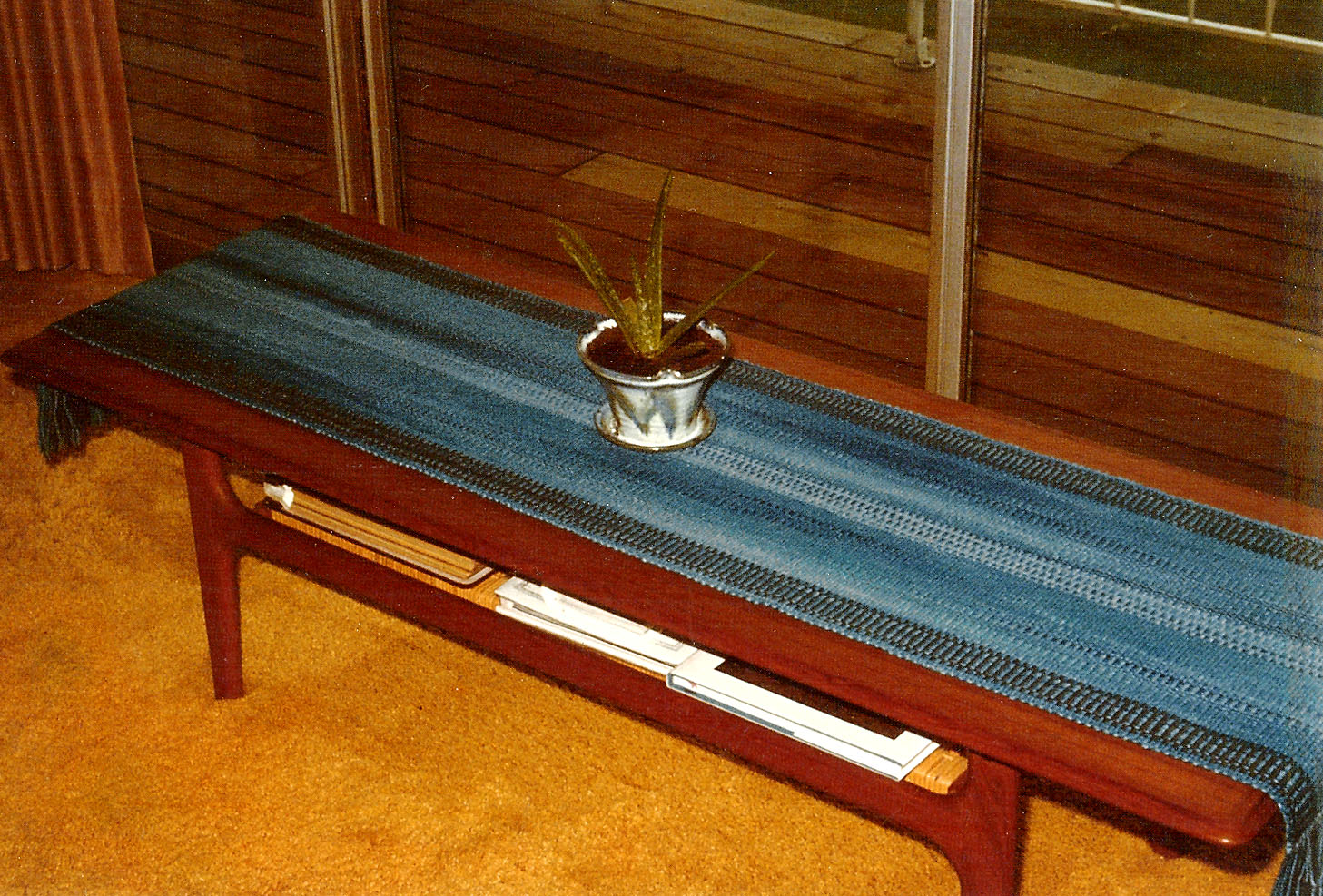
In a warp-faced weaving, I would double up on the number of warp yarns I threaded on the loom.  When I wove, the weft would be totally covered by the warp, and disappear inside the weaving.

Warp-faced table runner.  Hand-dyed yarns.
***
Warp-faced table runner.  Hand-dyed yarns.
Next post:  back to Nantucket.

Friday, July 14, 2017

1982 (14) – Ed’s Weaving

Ed's hand-dyed and hand-woven scarves

When we lived in Ann Arbor, Michigan – before we sailed off on Tropic Moon – we both had looms and wove as a hobby.  With our previous experience, we felt confident enough in our skills to take the jobs as weavers at Nantucket Looms.  I thought I’d provide some background pictures.

Ed’s start as a weaver came when he asked me to weave a winter scarf for him.  I bought some brown wool and produced a scarf.  It was fairly rough wool, and when Ed wore it, his neck broke out in a rash.  He suggested that I might weave another scarf, maybe in fine mohair this time?  And since I was dying the wool I used, maybe I might dye the mohair and weave the scarf using a Scottish tartan pattern…?  Among other comments I made, I suggested he do the project himself.

Ed found a reference book on Scottish tartans at the University of Michigan library.  He bought white mohair yarn, dyed the colors he needed, and wove the scarf on my loom.  He even did the unforgivable – not dye enough yarn in one of the colors he was using.  He discovered the problem when he was most of the way through weaving the scarf.  Of course, he dyed more yarn and got the color to match.  In the end, Ed wove five scarves in traditional Scottish tartans.

Ed decided to weave some yardage in a tartan pattern to give to his mother for Christmas.  He wove three yards.  When Grace opened the gift, she admired the fabric.  Even though she knew Ed was weaving, I could see she didn’t have a clue. 


“Your son wove that fabric for you,” I told her.

A few tears were shed.

Grace made a lovely pleated skirt using the yardage Ed had woven for her.

Ed's mom, Grace, wearing her hand-woven skirt.

Next post:  some examples of my weaving.

Wednesday, July 12, 2017

1982 (13) - Weavers

Main Street, Nantucket

To go to the beginning of this book, Tropic Moon: Memories, click HERE.

The first month working at Nantucket Looms went really fast.  Ed and I both finished our warps of stoles - fifteen each - and they all sold.  We each did a scarf warp, also mohair, which yielded nineteen scarves.  It took me 2-1/2 days to weave my nineteen scarves.  Those sold too.  The mohair items really went like hotcakes! 

My next warp was navy blue wool, which would produce tweed fabric.  (The tweed fabrics were made up into wool shirts that were sold in the store.)  I dressed the loom with a warp that was 36 yards long.  There were 800 threads in the warp - 40 inches wide, at 20 warp ends/inch.  Back in Ann Arbor, I never would have believed I could weave 36 yards of anything….  I wove the first sixteen yards in four days.  I was surprised at how much I was enjoying the weaving.

Nantucket Harbor

It wasn't long before I was off the big loom.  The second week, Karen (another of the weavers) was late one day.  Sam, the manager, asked me to go downstairs and weave with him.  Just then Karen arrived and I told her, half-joking, "Boy, am I glad to see you!  I was going to have to go downstairs and weave with Sam."  Later Sam asked me if I didn't like working on the big loom.  I told him I was more comfortable on one of the smaller looms, but that I didn't really mind weaving on the big loom.  Sam said there wasn't any point in my doing it, if I wasn't enjoying it (seriously??), and that was that.  Ed was fine on the big loom, so he did the afternoon shift with Philip.  Sam and Karen wove on the large loom mornings and evenings.

When Ed finished his mohair scarves, Sam asked him to do a sampler similar to the project downstairs, which they would cut up and send to potential customers.  Ed worked on that project in the mornings.  The warp was fine linen, and there were 1200 warp ends, 30 ends/inch.  It took a while to thread a loom with 1200 warp ends!  For this special fabric, the weft was a thick plant fiber called Ramie.  For the sample project, Ed would weave with one, two, three, and then four thicknesses of Ramie.  Ramie was a naturally fireproof material.  This fabric was sold as wall covering for upscale offices in New York City. 

Nantucket

Ed also did some repair work on the looms.  The tie-ups to the treadles on the big loom were faulty - they had metal snaps that kept breaking.  Ed redid them with Dacron rope.  It also improved the ease of weaving on that loom.  When he started working with the linen on his loom upstairs, his brake kept slipping, so he rebuilt that too.  At first we were hearing, "But we've done it this way for 18 years....”  It wasn't long before they just let Ed go ahead and repair and improve things.

Monday, July 10, 2017

1982 (12) - Nantucket

This building housed Nantucket Looms when we worked there.
When we revisited Nantucket in 2010, Nantucket Looms
had moved up Main Street, and this building was Ralph Lauren.

To go to the beginning of this book, Tropic Moon: Memories, click HERE. 

Needless to say, we didn’t store much winter clothing on Tropic Moon.  After committing to jobs at Nantucket Looms, we did some really quick traveling.  We sailed to Newport, Rhode Island, where we met up with my folks, and some of my Connecticut relatives.  My parents, who were living in Florida at that time, had been visiting family in Connecticut.  When my parents were ready to head south again, I drove with them to my sister’s home in Virginia, where I collected my winter clothing.  I returned to New London, CT, by train.  A cousin drove me from New London to Newport, Rhode Island, where Ed waited with Tropic Moon.

From Newport, Ed and I sailed to Orient, on the eastern tip of Long Island.  Ed’s parents met us there on Labor Day, with the remainder of our winter things, including jackets and boots.  We sailed back to Nantucket, and started working at Nantucket Looms on September 14th.  We moved into the studio apartment on October 1st.  I got a library card, and we opened a checking account at a local bank.  It was surprising how quickly we could revert back to land life.

August 19th was the annual Sandcastle Competition at Jetties Beach.

The first week of work at the Looms set the tone for the winter.  We were both trained on the large loom on the main floor.  That loom was seven feet wide!  Two people wove at the same time, throwing the shuttle back and forth to each other.  The major wall covering project - and the reason we were hired - was being woven on that loom.  Ed and I also each had a loom upstairs, where we put on about forty yards of warp to weave off mohair stoles (22" x 84").  One warp would produce fifteen stoles.  We were told we were supposed to weave 3-4 stoles in a day. 

A sand castle, altered in Photoshop

After Ed wove his first four stoles, he had to cut his warp to remove them, because someone was waiting for a gray stole.  That one sold, and two others were gone in two days.  The first stole was considered a "throw-away" because that's when you're getting used to the technique.  The Looms were continually out of stoles - they would sell as soon as they were woven, some customers buying three or four.  Another big item was mohair "chaise throws," (translate to blanket), that were 4 x 7 feet.  They, too, would sell out right away.  Mohair scarves, called “ascots,” were also very popular. 

A view down the beach.

The first Friday in October, a gale hit Nantucket with winds of 45-50 mph.  Torrential rains turned Main Street into a river; the sky was as dark as night.  After work, Ed went to Tropic Moon to check on her.  I went to the supermarket to shop for my first dinner in the apartment.  I bought a gorgeous steak, and little potatoes, and corn on the cob from a local farmer.  I also had some small onions to boil, and a flan for dessert.  When I reached the apartment, the electricity was out - no lights, heat or stove.  I made sandwiches before it got totally dark.  When Ed hadn't shown up by 6:15 p.m., I headed to the marina.  Since Tropic Moon’s electricity came from a bank of batteries, I knew the boat would at least have lights.  I told Ed I'd come home again.

Wednesday, March 11, 2009

Weaving Fabric Strips - Demo of Sorts!

When I finished my last post and said I might weave fabric strips again, I didn't expect to do it so soon.... But I thought I might be able to do a better explanation of my technique and show pictures of the process. Not realizing I was making things difficult for myself, I decided to weave strips to form the word, HEART. "Heart" has always been one of my favorite words. It's a great word to "assemble." First, start with an "ear." With an "ear" you "hear" (add the "h"). And when you truly "hear" someone, then you're listening with (add the "t") your heart.

More on my process. In Photoshop, I made a large word that said HEART, and did two images, one with the word in purple and one in red. I then made the images 8"x10" and used my inkjet printer to print the images onto cotton fabric. (I use "Colorfast" Printer Fabric Sheets.)


The printer fabric sheets come with a backing, which I removed. I then added Wonder Under to the backs of the fabric sheets. I add the Wonder Under so that when I'm done weaving the strips together, I can press the new piece and it will be fused together. I leave the paper backing on the Wonder Under until after I've cut the strips.

The trick to this technique is that one image is cut in horizontal strips while the other image is cut in vertical strips. Here are scanned images (click on image to enlarge) of the pieces after I'd cut them into strips. As I said in my last post, I cut curved lines instead of straight lines to make a more interesting final fabric.


In the past, when I had woven fabric strips for quilt backgrounds, it didn't matter if the strips lined up perfectly or not. When you're trying to do a specific image, like a word, it turns out it does matter, and thanks to the thickness of the fabric, the weaving wasn't working! I ended up using a scissors to trim a little off of each of the vertical strips, which made them fit together a whole lot better. Here's a scanned picture of the final woven fabric.


Despite a bit of frustration with the weaving, I'm happy with the way it came out. Now I'm thinking about quilting it and embellishing it and maybe mounting it on an 8x10 painted canvas.

Saturday, March 7, 2009

Weaving Fabrics for Art Quilts

Butterfly Garden
The idea of weaving strips of fabric together to make backgrounds for art quilts intrigued me. The first art quilt I constructed with this method was Butterfly Garden, which I made in 1999.


The two shades of green in the background are hand-dyed batik fabrics which I cut into strips and wove together. The technique is to cut one of the fabrics into vertical strips and the other fabric into horizonal strips. I made a point of cutting curved strips because, surprisingly, they weave together beautifully and are more interesting than straight cuts. I used silk flowers, bumblebees, and frogs to embellish this art quilt. Here's a detail image from Butterfly Garden. You can click on any of my images to see an enlarged version.


This technique of weaving fabric strips was also used in "Purple Flowers" (2003), and for the clothing in "Picasso's Harlequin" (2000).


This was an interesting art quilt to do because it started out to be a watery landscape. (Don't ask!) It began with a blue and pink batik fabric. I sliced that fabric into vertical strips and wove it with two other fabrics - cut into horizontal strips - a pink batik on the top half, and an aqua batik on the bottom half of the background.


If you look at the detail picture, you'll have a close-up view of the flowers I used. As I was cutting them out of the fabric they were printed on, I noticed that what I had left over was also shaped like a flower, but in the negative. That was intriguing, and that was when I decided to try for a vase of flowers instead of that watery landscape. I fused on leaves from another fabric, and finished the quilt with some buttons for the centers of a few of the "negative" flowers.

This quilt is an adaptation of the Picasso painting. Old clothing from the thrift shop was used for the fabrics. The harlequin's outfit was made from strips of two fabrics that were woven together. The figure was constructed separately and then attached to the background. The pieces of lace were the cuffs and collar of an old blouse. The "hair" is from a black velvet bolero jacket.


I enjoyed weaving fabrics for these art quilts, and was really pleased with the effect produced. May do it again sometime!

Thursday, March 5, 2009

Uncommon Cloth

Several years ago, when I started planning for my website, I spent a fair bit of time trying to decide on a name for it. I had planned to purchase a domain name so that I could be a dot-com, and I wanted the name to be something that I could live with for the long term. My creative work back then involved art quilts - exclusively - and after about two weeks of periodic musing on the subject, I came up with the name Uncommon Cloth. I applied for, and got the domain name.

The photo on the right is a detail from one of my art quilts, Yellow Bird. The background is a piece of silk that I had painted before using it in the quilt.

Fast forward to current days - I don't do as much art quilting now as I used to, and am more into painting and mixed media. Not everything I work with is cloth! Still, I didn't want to change the name so I decided it was time to do some creative thinking about what "cloth" really means to me. First, the painting was no problem because it's done on canvas, which is a cloth. Most of my mixed media is also done on canvas, and often involves fabric, so that was covered too. Photoshop projects? I print notecards and ACEOs onto paper. Paper is fiber, cloth is fiber.... I can live with that too.
And then there's the idea of the overall tapestry of our lives. This next paragraph is something I wrote, back in the late 80's, and it's expressed from a spirit guide's point of view.
TAPESTRY. Every day brings new life, new opportunities for creating - an immense tapestry that you "weave" thread by thread. You control the final product. What colors you use, how rich the thread, how elegant or how poor the final result will be your choice because it is a matter of how you live every day of your life. You work with the richest silks, the finest cottons. The colors you choose cover the full spectrum, bright and shiny or dark and dim with your moods. Every color, every tint, every shade of each hue. Weave with a light touch. Stitch with a carefree hand. Let the pattern emerge as it should - as it will. Hold your needle or bobbin or shuttle lightly, my dear, and if you wish, we will help to guide your creative hand, help you to weave your personal tapestry, the image, the visual representation, of the complex workings of the soul's creation.
When I was done thinking about this, I felt reassured about the name, Uncommon Cloth, because this isn't just about the cloth of my life, but, indeed, about the "uncommon" cloth as well.
Here's another sample of my work. Tiffany Irises is a tapestry that I had woven many years ago, and it's still one of my favorite pieces. I used yarns that I had hand-dyed in this weaving.