Showing posts with label Nantucket Looms. Show all posts

Sunday, July 23, 2017

1983 (2) – Spring in Nantucket

Mickey and Minnie in the Daffodil Festival parade.

To go to the beginning of this book, Tropic Moon: Memories, click HERE.

When spring arrived, Ed was spending all his free time working on Tropic Moon.  So many boat problems cropped up, Ed was starting to wonder if we’d ever be able to leave Nantucket.

Daffodil Festival Parade, Nantucket

Sending out samples of the wall covering fabric worked a charm.  By early April, Nantucket Looms had orders for 1500 yards of the linen/ramie material.  We had planned to leave our jobs at the end of April, but Ed offered to continue weaving through May, on a rainy-day-only basis (when he couldn’t work on the boat).  The owners gave Ed bonus checks, as enticement to continue with the project.

The three children were daughters of Nantucket Looms staff

At the end of April, Nantucket held their annual Daffodil Festival, which was a series of events to celebrate springtime awakening on the island.  Included was an antique car parade.  Nantucket Looms was open on Saturdays, so while we were all there to work, not much got done as we spent most of the morning watching the parade.  A tailgate picnic in Siasconset followed the parade.  Bill and Andy (the owners), locked up The Looms, and we all took food we'd prepared out to 'Sconset for the picnic.  We had about twenty in our group.  There were several hundred people at the picnic.

Bill, one of the owners of Nantucket Looms
When May 1st rolled around, The Looms’ had orders for 500 yards of the linen/ramie that were due June 1st.  That meant six warps, with Ed doing one or two of them, and another four weavers taking on the other four warps.  Only Ed wove fast enough to do two of the warps in one month.  Ed’s salary went from $6/hour to $14/yard.  (The wall covering sold for $100/yard.)  Since I’d stopped weaving, I’d go in to The Looms to wind bobbins for Ed.  In 45 minutes, I’d wind enough bobbins for Ed to weave for three hours.

At the 'Sconset picnic.  Andy, the other owner of Nantucket Looms,
is on the right, Sam is in the back, and Philip is bent over the food.

The extra money Ed earned was much appreciated.  As we well knew, Tropic Moon embodied the definition of a boat:  a hole in the water into which you pour money….

Winner for Best Window Decoration during the Daffodil Festival

Tuesday, July 18, 2017

1983 (1) – Nor’easter

Tropic Moon, in the Nantucket marina.  An early winter photo.  That's snow
on the decks, and some ice in the water.  Faith Jones is on the left in the photo.

To go to the beginning of this book, Tropic Moon: Memories, click HERE.

In February, Nantucket was hit by a nor’easter.  We didn’t know how much snow we’d gotten, but guessed it was around two feet.  No one could measure the depth.  The wind was so strong there were places completely blown free of snow, and other areas where the snow had drifted to six feet. 

After dinner on the night of the storm, Ed went to the marina to spend the night on Tropic Moon.  When he got there he discovered that our neighbor, Faith Jones, a 50-foot wooden boat, had broken loose.  It was banging against the pilings between the two boats.  The force had shifted one of the pilings, so our ropes had slackened, and Tropic Moon was hitting the dock.  Faith Jones had ripped out part of her deck and cap rail.  There was a big, gaping hole near the stern that matched the hole on the other side of the boat caused during an earlier storm. 

Ed got someone from another boat to help.  (Faith Jones’ owner was in California, and a local person was supposed to be watching the boat.)  The two of them worked to get Faith Jones retied.  It took them till 2:00 a.m.  Ed didn’t get much sleep that night because he was checking on things all night long.  That was a Friday.  We had Saturday off from work because of the storm, and Ed slept most of the day.

It was two or three days after the storm when Ed went back to the marina to check on Tropic Moon.  He noticed that Faith Jones was sitting very low in the water.  The waterline was six inches under water!  There was an old man on a barge houseboat nearby.  When Ed pointed out the problem to him, the man agreed that the boat was sinking – and then went about his own business…. 

Ed walked to the Chandlery and told Pete, the owner of the marine store.  Pete came to look at Faith Jones, but wouldn’t call the Coast Guard.  Instead, he phoned the local guy who was supposedly watching the boat.  When that man arrived, they called the Coast Guard, who came with two pumps, and pumped out the boat.  A hose inside Faith Jones wasn’t connected to anything, and had started taking in water.  The boat was definitely headed for the bottom.  Ed gave the man one of our wooden plugs to stop up the hole.

During the storm, another sailboat, unattended, had banged into the dock until it broke off a six-foot bowsprit.  There was quite a bit of damage around the harbor.  Thanks to having a steel hull, Tropic Moon only lost a little paint on the rub rail.  But she was suffering the effects of a long, cold winter.  The teak on the cabin top had contracted in the cold, and the varnish had lifted off in sheets.  The hull paint was peeling; Tropic Moon was looking a little shabby.  With a long list of boat projects, we had our work cut out for us, before we’d be able to leave in the spring.

Saturday, July 15, 2017

1982 (15) - Jean's Weaving

After finishing this small weaving, I added the flowers using cross stitch.
I had dyed the yarns.

As I mentioned in the last post, these are some examples of my weavings from our time in Ann Arbor.

Airy-Fairy Weavings (my name for them...):

Small wall hanging.
***
Large Wall Hanging
***
Weft-faced Weavings:
In these weavings, the warp threads are spaced far apart.  When you weave, and beat down the weft yarn, the warp is totally covered - hence, 'weft-faced.'

Large wall hanging; hand-dyed yarns
***
Detail.
***
Large wall hanging; hand-dyed yarns
***
Large wall hanging; hand-dyed yarns
***
Detail.
***
Large Wall Hanging.  Purchased yarns.
***
Pillows

***
Warp-faced Weavings:
In a warp-faced weaving, I would double up on the number of warp yarns I threaded on the loom.  When I wove, the weft would be totally covered by the warp, and disappear inside the weaving.

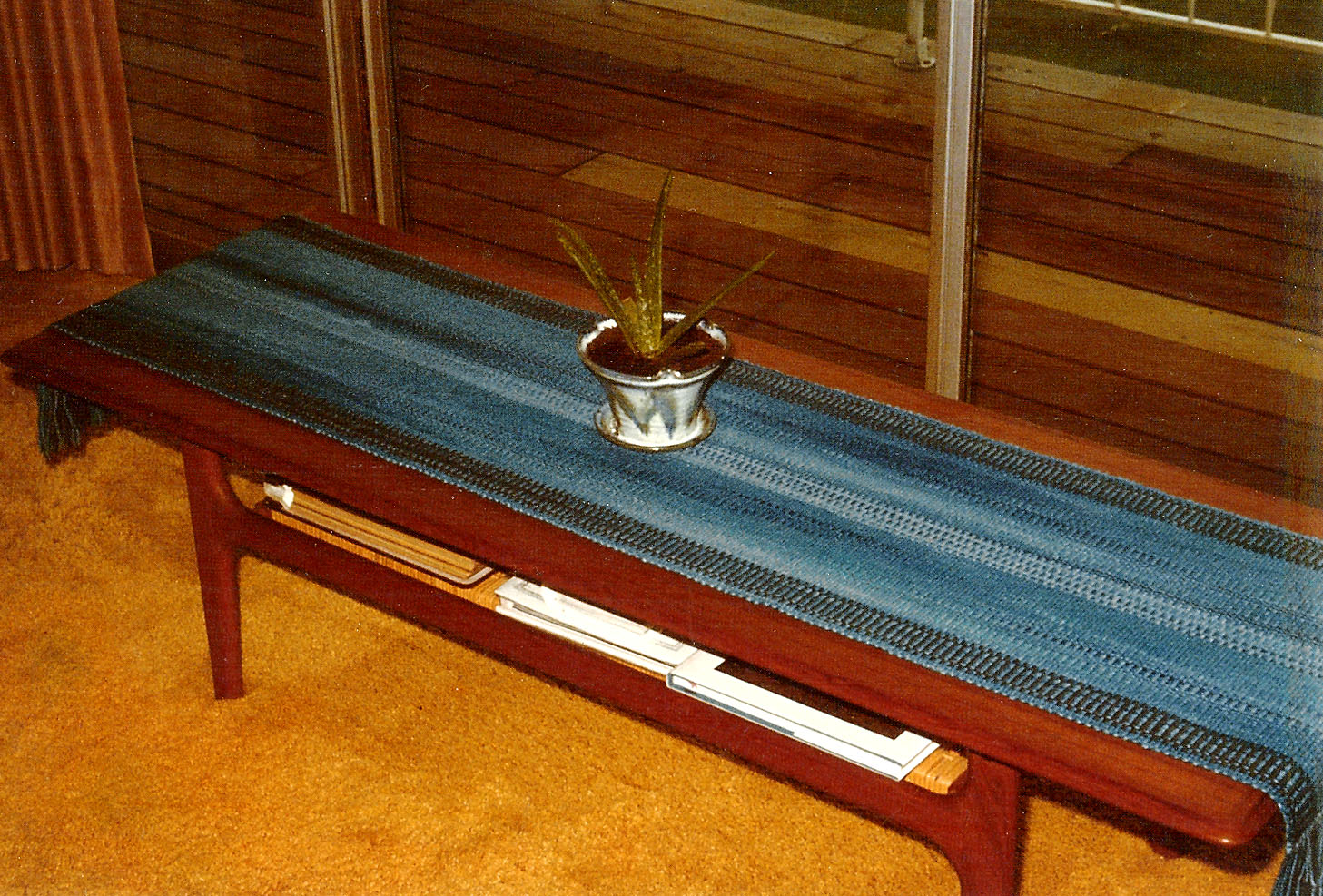
Warp-faced table runner.  Hand-dyed yarns.
***
Warp-faced table runner.  Hand-dyed yarns.
Next post:  back to Nantucket.

Friday, July 14, 2017

1982 (14) – Ed’s Weaving

Ed's hand-dyed and hand-woven scarves

When we lived in Ann Arbor, Michigan – before we sailed off on Tropic Moon – we both had looms and wove as a hobby.  With our previous experience, we felt confident enough in our skills to take the jobs as weavers at Nantucket Looms.  I thought I’d provide some background pictures.

Ed’s start as a weaver came when he asked me to weave a winter scarf for him.  I bought some brown wool and produced a scarf.  It was fairly rough wool, and when Ed wore it, his neck broke out in a rash.  He suggested that I might weave another scarf, maybe in fine mohair this time?  And since I was dying the wool I used, maybe I might dye the mohair and weave the scarf using a Scottish tartan pattern…?  Among other comments I made, I suggested he do the project himself.

Ed found a reference book on Scottish tartans at the University of Michigan library.  He bought white mohair yarn, dyed the colors he needed, and wove the scarf on my loom.  He even did the unforgivable – not dye enough yarn in one of the colors he was using.  He discovered the problem when he was most of the way through weaving the scarf.  Of course, he dyed more yarn and got the color to match.  In the end, Ed wove five scarves in traditional Scottish tartans.

Ed decided to weave some yardage in a tartan pattern to give to his mother for Christmas.  He wove three yards.  When Grace opened the gift, she admired the fabric.  Even though she knew Ed was weaving, I could see she didn’t have a clue. 


“Your son wove that fabric for you,” I told her.

A few tears were shed.

Grace made a lovely pleated skirt using the yardage Ed had woven for her.

Ed's mom, Grace, wearing her hand-woven skirt.

Next post:  some examples of my weaving.

Wednesday, July 12, 2017

1982 (13) - Weavers

Main Street, Nantucket

To go to the beginning of this book, Tropic Moon: Memories, click HERE.

The first month working at Nantucket Looms went really fast.  Ed and I both finished our warps of stoles - fifteen each - and they all sold.  We each did a scarf warp, also mohair, which yielded nineteen scarves.  It took me 2-1/2 days to weave my nineteen scarves.  Those sold too.  The mohair items really went like hotcakes! 

My next warp was navy blue wool, which would produce tweed fabric.  (The tweed fabrics were made up into wool shirts that were sold in the store.)  I dressed the loom with a warp that was 36 yards long.  There were 800 threads in the warp - 40 inches wide, at 20 warp ends/inch.  Back in Ann Arbor, I never would have believed I could weave 36 yards of anything….  I wove the first sixteen yards in four days.  I was surprised at how much I was enjoying the weaving.

Nantucket Harbor

It wasn't long before I was off the big loom.  The second week, Karen (another of the weavers) was late one day.  Sam, the manager, asked me to go downstairs and weave with him.  Just then Karen arrived and I told her, half-joking, "Boy, am I glad to see you!  I was going to have to go downstairs and weave with Sam."  Later Sam asked me if I didn't like working on the big loom.  I told him I was more comfortable on one of the smaller looms, but that I didn't really mind weaving on the big loom.  Sam said there wasn't any point in my doing it, if I wasn't enjoying it (seriously??), and that was that.  Ed was fine on the big loom, so he did the afternoon shift with Philip.  Sam and Karen wove on the large loom mornings and evenings.

When Ed finished his mohair scarves, Sam asked him to do a sampler similar to the project downstairs, which they would cut up and send to potential customers.  Ed worked on that project in the mornings.  The warp was fine linen, and there were 1200 warp ends, 30 ends/inch.  It took a while to thread a loom with 1200 warp ends!  For this special fabric, the weft was a thick plant fiber called Ramie.  For the sample project, Ed would weave with one, two, three, and then four thicknesses of Ramie.  Ramie was a naturally fireproof material.  This fabric was sold as wall covering for upscale offices in New York City. 

Nantucket

Ed also did some repair work on the looms.  The tie-ups to the treadles on the big loom were faulty - they had metal snaps that kept breaking.  Ed redid them with Dacron rope.  It also improved the ease of weaving on that loom.  When he started working with the linen on his loom upstairs, his brake kept slipping, so he rebuilt that too.  At first we were hearing, "But we've done it this way for 18 years....”  It wasn't long before they just let Ed go ahead and repair and improve things.

Monday, July 10, 2017

1982 (12) - Nantucket

This building housed Nantucket Looms when we worked there.
When we revisited Nantucket in 2010, Nantucket Looms
had moved up Main Street, and this building was Ralph Lauren.

To go to the beginning of this book, Tropic Moon: Memories, click HERE. 

Needless to say, we didn’t store much winter clothing on Tropic Moon.  After committing to jobs at Nantucket Looms, we did some really quick traveling.  We sailed to Newport, Rhode Island, where we met up with my folks, and some of my Connecticut relatives.  My parents, who were living in Florida at that time, had been visiting family in Connecticut.  When my parents were ready to head south again, I drove with them to my sister’s home in Virginia, where I collected my winter clothing.  I returned to New London, CT, by train.  A cousin drove me from New London to Newport, Rhode Island, where Ed waited with Tropic Moon.

From Newport, Ed and I sailed to Orient, on the eastern tip of Long Island.  Ed’s parents met us there on Labor Day, with the remainder of our winter things, including jackets and boots.  We sailed back to Nantucket, and started working at Nantucket Looms on September 14th.  We moved into the studio apartment on October 1st.  I got a library card, and we opened a checking account at a local bank.  It was surprising how quickly we could revert back to land life.

August 19th was the annual Sandcastle Competition at Jetties Beach.

The first week of work at the Looms set the tone for the winter.  We were both trained on the large loom on the main floor.  That loom was seven feet wide!  Two people wove at the same time, throwing the shuttle back and forth to each other.  The major wall covering project - and the reason we were hired - was being woven on that loom.  Ed and I also each had a loom upstairs, where we put on about forty yards of warp to weave off mohair stoles (22" x 84").  One warp would produce fifteen stoles.  We were told we were supposed to weave 3-4 stoles in a day. 

A sand castle, altered in Photoshop

After Ed wove his first four stoles, he had to cut his warp to remove them, because someone was waiting for a gray stole.  That one sold, and two others were gone in two days.  The first stole was considered a "throw-away" because that's when you're getting used to the technique.  The Looms were continually out of stoles - they would sell as soon as they were woven, some customers buying three or four.  Another big item was mohair "chaise throws," (translate to blanket), that were 4 x 7 feet.  They, too, would sell out right away.  Mohair scarves, called “ascots,” were also very popular. 

A view down the beach.

The first Friday in October, a gale hit Nantucket with winds of 45-50 mph.  Torrential rains turned Main Street into a river; the sky was as dark as night.  After work, Ed went to Tropic Moon to check on her.  I went to the supermarket to shop for my first dinner in the apartment.  I bought a gorgeous steak, and little potatoes, and corn on the cob from a local farmer.  I also had some small onions to boil, and a flan for dessert.  When I reached the apartment, the electricity was out - no lights, heat or stove.  I made sandwiches before it got totally dark.  When Ed hadn't shown up by 6:15 p.m., I headed to the marina.  Since Tropic Moon’s electricity came from a bank of batteries, I knew the boat would at least have lights.  I told Ed I'd come home again.

Saturday, July 8, 2017

1982 (11) – A Change of Plans

Nantucket Lighthouse.  Acrylic Painting, 16" x 20"

To go to the beginning of this book, Tropic Moon: Memories, click HERE.

Edgartown, on Martha’s Vineyard, was a harbor that offered lots of services, most of which we passed up on, as they all cost money.  But we did take advantage of the launch service, as we were anchored a mile down the harbor from the town.  Launches ran frequently, and responded to three toots of the horn.  We depended on the launch while we were at Edgartown, and never even took the dinghy off the deck, where we stored it on passage.  We went in to town for a movie one night, and were returning to the boat at 9:00 p.m.  It was so foggy, you couldn't see from one boat to the next.  It was really tricky locating people's boats, as there were over a hundred anchored in the harbor. 

After Kathy and Bill left on August 9th, the weather turned bad, with rain and fog.  We had been down in the Caribbean for too long.  When the temperature dropped to 70 degrees in the boat, I was wearing my thermal underwear, with a floor-length flannel nightgown, and we were buried under wool blankets.  We were planning to sail from Martha's Vineyard to Nantucket, and we waited a few days before leaving.  Thanks to the fog, the weather report was listing zero visibility at Nantucket.

Kathy and Bill had asked us what we’d be doing for the winter; we answered that we had no set plans.  We assumed that, after summering in New England, we would spend the fall in the Chesapeake, and then head south to Florida for the winter.  All those plans went out the porthole when we sailed into Nantucket the following week.  While walking around the lovely old whaling town, we stopped to visit Nantucket Looms, where people were working as hand weavers, producing beautiful crafts and fabrics. 

Mileage chart on the side of the Nantucket Looms building.

We hung around; we talked about our travels, and the fact that we'd both woven as a hobby, back in Michigan.  We chatted with Andy, the head weaver, who was also one of the owners.  I left for a while to satisfy a craving for French fries.  By the time I returned, Ed had been tentatively offered a job.  He was enthusiastic at first, but then decided it would be boring, since it involved weaving hundreds of yards of fabric.  But by then I knew I wanted to stay at Nantucket, and talked Ed into it, despite our qualms about wintering the boat at the island.  Since I wasn't willing to spend another year sitting around while Ed worked, like I'd done in Tortola, we told the folks at Nantucket Looms that we'd both like jobs.  They had large orders to complete over the winter, and we were both hired.

In one week on the island, we not only landed jobs, but I found us a studio apartment, and arranged dockage (winter storage) for Tropic Moon at the marina.  The cost for the boat slip was $350 for the whole winter!  The studio apartment was on Easy Street.  (Yes, I loved telling people we were living on Easy Street).  The apartment was within two blocks of Nantucket Looms, the boat basin, and the supermarket.