Showing posts with label Sunnie. Show all posts

Monday, May 15, 2017

1980 (30) - St. Barths

Dunescape.  An art quilt.  43" x 53"

To go to the beginning of this book, Tropic Moon: Memories, click HERE.

An overnight sail from Antigua took us north to the island of St. Barths.  So many cruising people we met praised St. Barths to the sky.  Since we’d found it pleasant during a previous three-day visit, we decided to spend a few more days there.  Whatever mystique this small French island held for others continued to elude us.  But then, if everyone had the same favorite island, there would be a rather lopsided distribution of boats through the Caribbean.  I’ve seen more than one puzzled expression when I list Antigua as my favorite.

St. Barths.  Postcard.  

One morning we rowed in to Gustavia, St. Barths only town.  In about an hour, we’d seen all there was to see in the shops.  Ed then proposed we hike across the island.  While that idea would normally intimidate me, I’d seen, on the chart, that St. Barths was very narrow in the middle (only 1-1/2 miles across).  The hills didn’t look too imposing, so we headed up one of the roads leaving town.  The winding road wove back and forth up the hill, so cars wouldn’t have too steep a climb.  While we meandered our way upward, we would glance back to see the picturesque Gustavia, with its red-roofed buildings, forming three sides of the rectangular harbor basin. 

Once in the hills, we began watching for the miniature airport we’d seen pictured on one of my postcards.  We knew we were getting close when a small plane literally flew through the trees ahead of us.  When we came to the opening, we were at the top of a steep hill.  We gazed down to see a short runway running from the bottom of the hill, to the sea beyond.  While standing there, we heard a “whoosh” behind us and turned to see a small plane climbing the hill.  We ducked as it went overhead.  It swept down the hill, touched down on the runway and came to a stop, just yards before it would have plopped into the sea.  We saw several landings, mostly thanks to one two-seater that was doing practice touchdowns.  And I ducked every single time, as the planes seemed to top the hill at such a low altitude.

Low-flying aircraft.  Internet photo

Since I liked to have incentive to go along with my exercise, and I’d read in our cruising book that there were restaurants ringing the bay below us, I told Ed I’d continue on in exchange for a lunch out.  We walked down the hill (with nervous glances over my shoulder for low-flying craft).  We continued along a road with the runway on one side, and fields, and an above-ground cemetery on the other side.  We returned to sea level at Baie St. Jean.  We left the road to walk on the beach for its entire length, checking out all the restaurants and reading the posted menus.  We settled on one called the “Beach Club” and enjoyed delicious fish dinners.  After the exercise, and the filling lunch, I wanted to be instantaneously transported back to the boat and my bunk for a nap.  Unfortunately, the only choice was to hike back.  Since we had less cause to dawdle, we were relaxing on Tropic Moon by mid-afternoon.

Dunescape.  Detail.  I used yarns, lace, and feathers in this quilt.
Our four days in St. Barths were followed by a week in St. Maarten, where we visited with Sunnie.  Adhering to our time schedule (yes, we actually had one), we headed “home” to the British Virgin Islands.  An overnight sail returned us to Tortola in time for our haul out at Nanny Cay Boatyard on December 1st.

Saturday, April 15, 2017

1980 (18) - St. Maarten

Collaged postcard.  Hand-painted silk.  4" x 6"  by Jean Baardsen

To go to the beginning of this book, Tropic Moon: Memories, click HERE.

Mother’s Day had fallen on the weekend we were in Antigua.  On Saturday, we went to the Cable & Wireless building to call our mothers.  For one thing, I wanted to check on my sister, Lynn.  She’d been due to have a baby two days before.  I knew my Mom was planning to help her, so I put the call through to my sister’s home in Virginia.  Reaching my Mom, I learned that Lynn had delivered her second son, Danny, on the day he was due. 

Now for a bit of back-story.  In 1960, when I was in the 7th grade, and Lynn was in the 5th grade, my father, a sergeant in the Air Force, was transferred to Selfridge Air Force Base in Mt. Clemens, Michigan.  When we moved there, base housing wasn’t available, and we looked for a house in town.  We rented a house owned by Dorothy and Bill Noellert – whom I’ll now refer to as Bill (1).  They had three children – Sunnie, Bill (2), and Ray.  Dorothy was pregnant with their fourth child.  Liking my sister’s name, they called the new baby girl, Lynn – now referred to as Lynn (2).  Our families were close, but little did anyone imagine that when we grew up, my sister, Lynn (1), would marry their son, Bill (2).  That made Lynn (1) sister-in-law to Sunnie, Ray, and Lynn (2).  When Lynn (1) and Bill (2) were expecting their first child, Bill (1) died of a heart attack.  Thus, they decided to name their first son, Bill (3). 

Palm Trees.  Digital Art by Jean Baardsen

Now back to May 1980.  During the course of the conversation with my Mom, she mentioned that Lynn’s mother-in-law, Dorothy, and Lynn’s sister-in-law, Lynn (2), were visiting Sunnie in St. Maarten.  Yes, the Sunnie who visited us in Grenada, and whom I’d worked with at International Supply during our stop in St. Maarten the year before.  Dorothy and Lynn would be in St. Maarten for most of the next week.  After that, they’d be flying to Virginia to visit Lynn (1), Bill (2), Bill (3), and newborn, Danny.  My parents would still be at my sister’s house.  (Okay, I’ll drop the numbers…)

I told my Mom I was sorry we weren’t going to be able to meet up with Dorothy and Lynn.  We wouldn’t reach St. Maarten in time, since we were planning to stop at St. Barths first.  Back on the boat, Ed and I decided it would be fun to buzz straight up to St. Maarten to see them.  That way, when they reached Virginia, they’d be able to tell my Mom they’d seen Tropic Moon and us.  We had bought Tropic Moon in Grenada in 1978, and had yet to leave the islands, so none of our family had seen our boat.

We left Antigua on May 11th at 6:00 p.m., and reached Philipsburg, St. Maarten, at noon the next day.  We had another uneventful sail; I was starting to feel quite optimistic about the whole sailing business.  Once on shore, we walked to International Supply, where we surprised Sunnie.  We also saw James, Sunnie’s boyfriend (and future husband).  James’ parents owned a vacation home on St. Maarten.  While Sunnie and James usually lived on Sunnie’s houseboat, they were spending that week with Dorothy and Lynn at the villa in the hills.  Sunnie called Dorothy to say she was bringing us home for dinner, and James invited us to stay for the night.

When the family wasn’t using the villa, it was rented out to vacationers.  The house came with two cars, and a maid.  It was high in the hills, overlooking vistas of bays and ocean, with the island of St. Barths visible off to the south.  The house was beautiful – a long, one-story building, with ocean views from the living room, kitchen, and the three bedrooms.  A balcony ran along the ocean side of the living room.  A swimming pool was located in a secluded garden area off the end of the house.  Backing the living room and the hall was an outdoor shuffleboard court.  There was an indoor rec room with billiard table, and a cupboard full of games.  The living room had a stereo, a record collection, and four large bookcases filled with a variety of reading material.  All the rooms were furnished in rattan and bamboo.  There was an oriental rug in the living room, and ceiling fans in all the rooms.  The kitchen was decorated with three-foot tall ceramic animals perched above the cupboards. 

Fabric postcard, 4" x 6", Hand-painted silk, by Jean Baardsen

Dorothy and Lynn wanted to see Tropic Moon, so we invited them for lunch the next day.  Sunnie, who was bopping back and forth from work to provide chauffeur service, took us to the dock in the morning.  Dorothy and Lynn liked our boat, but the very (very!) gentle rocking at anchor bothered them.  They both got queasy, but wanted to stick it out – and even managed to eat lunch.  They were very glad to get back on shore again. 

Dorothy’s comment to me:  “I can’t believe how well you’ve adjusted to this life!”
Loose translation:  I can’t understand how you can live like this!  (So much for a good report to my Mom…)

Sunnie showed up, and we barreled back through the hills to the house.  Ed had decided to stay on Tropic Moon, but I wanted another night in the villa.  Sunnie dropped us off at the house and went back to work.  Dorothy and Lynn napped through the afternoon to sleep off their seasickness, and I had the house to myself.  I accepted a delivery of chlorine for the swimming pool, did the breakfast dishes, which we’d left in the sink, then stretched out on a chaise lounge.  I chose a John D. MacDonald mystery from the bookshelf.  One could really get used to living like that all the time.

(2017 Update:  Bill (3) turns 40 this year.  He and his wife, Cate, have two young sons.  Happily, neither of the boys is named Bill.)

Sunday, January 29, 2017

1979 (10) - St. Maarten - Part 2

Me, in St. Maarten.  I was wearing my Bitter End Yacht Club t-shirt.

To go to the beginning of this book, Tropic Moon: Memories, click HERE.

Hanging around St. Maarten started to get old.  When Sunnie offered me a temporary job, I went to work for International Supply.  The company is a huge auto parts store, similar to the Western Auto’s back home.  A frantic sales counter served customers who stood around holding mufflers, tail pipes, and the like.  It was the only place in the Caribbean I’d seen that actually bustled.  

My first assignment was putting together their six-month paint order.  I also set up a cross reference system of part numbers for different manufacturers of exhaust systems, labeled stock, wrote up orders, and performed other tasks that were reminiscent of my library days.  As I was out of practice at working, I made it through five days, then took a three-day weekend, worked two more days, and haven’t been back for almost a week.  International Supply is starting five days of inventory, and I’m sure I can make myself useful updating their card system.  I got $30/day, and an employee discount at International Supply.

Mermaid of Carriacou

While waiting in St. Maarten, we took a three-day trip to sail to St. Barts, a French island about twelve miles south of St. Maarten.  Thanks to the prevailing winds, it was six hours over - and three hours back.  Our little trip gave us the opportunity to practice leaving and entering a harbor under sail, a good thing to know when your engine is less than reliable.  We did fine, which means we didn't run into any other boats.  While in St. Barts, we visited the stores and finished our Christmas shopping.  We had heard that the people there speak English, but the truth was, they spoke English about as well as I spoke French - vaguely.  I conducted the whole transaction in a bakery in French, which may sound good, but we ended up with turnovers stuffed with vegetables, instead of fruit.  It never occurred to me to ask what was inside of them. 

Post card from St. Barts

The engine parts never did arrive from England and, after a month, we finally gave up on them.  We left Sunnie's address with the post office in case the parts showed up.  We also cabled England again, asking them to initiate a trace, and to send replacements to Ed's parents' address in New York.  By that point, we had spent $100 on a $10 part, and still had nothing to show for it.  Sometimes things go that way.  We had made airline reservations to fly Stateside for the holidays, leaving Antigua on December 17th.  With only two weeks left to reach Antigua, and make arrangements for securing the boat, we figured that it was time to be on our way.

Church in St. Maarten

The day we planned to leave St. Maarten, we motored into Bobby's Marina for fuel and water.  We had a little trouble going in, as we had to drop an anchor off our bow, and back up between two other boats, to tie our stern to the dock.  Tropic Moon has a thing about going backwards - she won't if she can avoid it.  The wind was from astern, and we were trying to fend off from the two neighboring boats, which happened to be unoccupied.  A fellow came along the dock and caught our stern line to tie us off.  The docking rope slipped out of the cleat, came up against the wooden support for the dinghy engine, and started ripping off the wooden post.  We had Tropic Moon pulling one way, and this fellow on the dock pulling the other way. 

Ed reached in to grab the rope to put it back in the cleat.  In doing so, he managed to cut his finger open on a screw.  We got Tropic Moon secured, and Ed went below before I saw what had happened.  He bled all over cushion, deck and cockpit, and down below he sprayed the head with blood - it was on the toilet, sink, walls and mirror.  We did a little tourniquet on his finger, and used a Band-Aid to tape the ends together, which had received a long L-shaped cut.  The only way I can describe how bad the cut was, is to say that Ed almost went to the hospital for stitches (he has no use for doctors or hospitals), but then changed his mind.  I should have gone in for a sedative.  We filled up on fuel and water, rested awhile, and decided it was too late to leave for Antigua.  At 4:00 p.m., we reanchored in the bay.
Hibiscus


Friday, January 27, 2017

1979 (9) - St. Maarten

Anchorage at Philipsburg, St. Maarten

To go to the beginning of this book, Tropic Moon: Memories, click HERE.

We left Virgin Gorda October 11th, at 7:00 a.m., and arrived in St. Maarten the next night at 9:00 p.m. - after 38 long hours of sailing.  St. Maarten is 80 miles to the east of Virgin Gorda and, as there's generally a steady wind out of the east, it’s impossible to sail in anything resembling a direct path.  We had strong winds and were able to travel at 5-6 knots the whole way.  But, with all the tacking we did, we actually sailed 200 miles to cover the 80 miles distance between the two islands.  It took far longer than expected, as we had planned on arriving in daylight.  Rather than spend another night at sea, we decided to try entering the harbor in the dark. 

Through the afternoon, as we made our slow progress toward the island, we compared the coastal features with the chart and picked out what appeared to be Philipsburg, the capital, and a port of entry.  I still wasn't overly confident that we'd even found St. Maarten.  I mean, how does one really know?  They don't put up signs or anything.  (Note:  This was way before GPS, and we didn’t have satellite navigation.  Our navigation tools consisted of a sextant, for sun sights, the compass, and the knot meter.)  When darkness fell, we could see a flashing light that verified our position.  Once near land, we dropped the sails and motored into the bay.  We couldn't make out any anchorage, as it was very dark, so when we were past the mouth of the harbor, we just dropped the anchor right there, left our stern light on, and collapsed into bed.  The next morning we raised the anchor and motored over to the other yachts to join the flock.

When we left Road Town for Virgin Gorda, after not sailing for a month, I felt that everything I had learned came together.  I had more confidence in what I was doing.  When we left Virgin Gorda to sail to St. Maarten, rather than staying at the wheel as usual, I went forward to attach halyards and jib sheets.  I raised the sails myself for the first time.  And, although we were alone on this 38-hour sail, I felt things went well, and I held up my end of the watches.  That is, until Friday morning, when we sighted St. Maarten about 25 miles away, dead into the wind.  We were making very little progress in the right direction.  I wanted to start the engine, and motor straight in, rather than face another day, and possibly another night, at sea.  The captain (a sailing purist), refused to discuss the matter.  I was furious, resigning my crew position.  I told the captain he could sail his own f***ing boat, and went below for several hours.  I made up for it later by coming on the wheel at 2:30 in the afternoon, and staying on till 9:00 when we finally anchored the boat.

L'Escargot, a restaurant in Philipsburg

October 20, 1979
St. Maarten, part of the Kingdom of the Netherlands, is a country on the southern part of a Caribbean island shared with Saint Martin, a French overseas collectivity. Its natural features span lagoons, beaches and salt pans. The capital, Philipsburg, has cobblestone streets and colorful, colonial-style buildings lining the Front Street shopping area. The port is a popular cruise-ship stop.

Sunnie (our friend from Ann Arbor, who had visited us in Grenada), worked for International Supply on St. Maarten.  Our mail was being sent to International Supply, and we were anxious to collect it.  On Monday, we tried to call IS from the phone company, but couldn’t get through.  Learning that IS was only a mile away, we walked over, where we found that Sunnie was on Antigua.  We were told she’d be back on Wednesday.  Since the phones still weren’t working, we walked over a second time.  We learned that when Sunnie flew in that morning, she hadn’t had picture ID with her landing papers.  She got kicked off the island!  She had to get on another plane, and fly back to Antigua.  While we were in the office, the phone rang.  We heard Bob say, “Hi, Sunnie, just a minute.”  Bob handed the phone to me, and I gave Sunnie quite a surprise.  (International calls were going through, but not local ones.  Go figure.)  Sunnie finally made it back to St. Maarten on Friday.

The Hustler, Arawak Motors, Antigua

After Sunnie straightened things out with immigration, she planned to go back to Antigua for another month.  Bob, who owned International Supply, had several companies on St. Maarten and Antigua, including Arawak, on Antigua.  Arawak is an automobile manufacturing company that makes the Hustler, a car with a fiberglass body.  Sunnie was managing the car company.  Arawak was turning out two cars a week, and wanted to increase production to six-ten cars per week.  Sunnie told us there was a big market for the Hustler in the Caribbean.  The car was good at climbing mountains and crossing rough terrain.  The car rental agencies in the islands liked to buy them. 

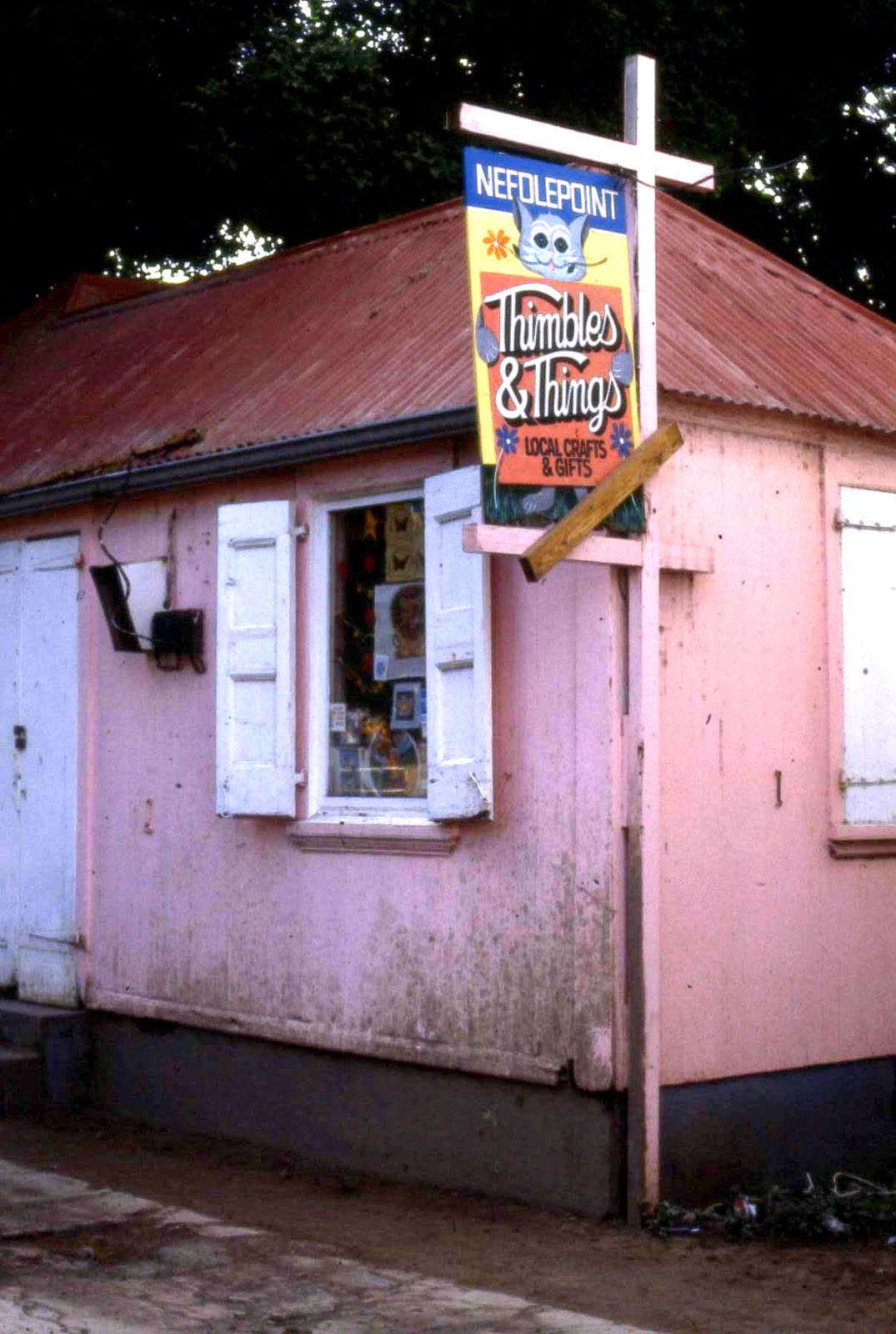
St. Maarten is a duty free port, with lots of nice shops.  We spent most of a day wandering through the stores.  My favorite was Thimbles & Things, which had imported needlepoint canvases from all over the world.  We were surprised to learn that Thimbles & Things is one of the companies Bob owns.

Thimbles & Things, Philipsburg, St. Maarten

October 29, 1979
The week after we arrived at St. Maarten, we took Sunnie and two of her friends, James and Joanie, out sailing.  James runs the fiberglass part of the auto company, and Joanie manages Thimbles & Things.  There was almost no wind for sailing.  After three hours, we weren’t very far out of the harbor.  We ended up going to the next bay, and anchoring there to go swimming.  I had fixed a lunch of Gazpacho, with cheese and rolls.  Sunnie brought a case of Heineken and a cooler of ice.

It was one of those classic situations where we had to be back by a certain time because James had a plane to catch.  Ed said, don't worry; we'll just start the engine and motor back.  Though the starter motor was sounding a little sick, the engine did get going, and we returned to Philipsburg on time.  I still haven't figured out why it worked when we needed it, because that was the last time the engine started.

Ed tried the engine again in the evening, and nothing happened except a click.  He took the starter motor apart and found myriad problems - rusted-out brushes, a broken tooth on the pinion gear, disintegrated insulation and insulating tape.  We weren’t able to find the parts we needed on St. Maarten.  Bob checked when he flew to Antigua, even visiting junkyards, with no luck.  Ed sent a cable to the place in England where we’d gotten engine parts before, and order replacements for the brushes and the pinion gear.  We cabled money from the British Barclays on St. Maarten.  What with cables, and shipping costs, we were paying $80 for a $10 part.  Ed’s hoping the parts will arrive this week.

As we generated our own power by running the engine to charge the batteries, no starter motor meant no engine, no power, and no lights at night.  It got dark at 6:00 p.m.  Cooking by kerosene lamp may evoke images of old-time sailors, but roughing it was never my idea of a good time.  Besides, if you don't have sufficient light in the galley, the cockroaches come out to forage, and I worried about one ending up in the dinner.  Though we probably wouldn't have noticed; it was too dark to see what we were eating.

We were without power for two weeks while Ed tried everything he could think of to get the engine going.  Tropic Moon has a 52-hp diesel engine that sits like a large green monster below the saloon floor.  Ed tried starting the engine manually by attaching a pulley system and rope to the flywheel, and pulling on the rope.  When it didn't work from inside the saloon, he threaded the pulley system through the hatch in the saloon roof.  Ed hung onto the rope, and jumped off the main boom, with continued negative results.  Our last attempts involved ropes threaded from the engine, out the hatch, up to the bow, with Ed and I running (sort of) along the deck hauling on the rope.  No go, and very embarrassing.  Someone, seeing all the ropes and pulleys and strange goings-on, asked Ed what he was building.  Ed then took a few days and rebuilt the starter motor, insulating all the coils, and using the broken pinion gear.  It was still too inefficient to start the engine by itself, but a combination of the weak starter motor and the pulley system finally did the trick.