Thursday, June 15, 2017

1982 (3) – Haul Out from Hell

Jungle Parrot.  This was my first art quilt, made in 1995.

To go to the beginning of this book, Tropic Moon: Memories, click HERE.

The day we were scheduled to haul out at Nanny Cay, we left Road Harbor early that morning.  As we motored over, the clutch started to burn up.  We re-anchored, and Ed spent several hours working on it.  We ended up hauling at 4:00 in the afternoon, instead of 9:00 a.m., our scheduled time.

When I tried to use the lights that night, they wouldn’t work.  Ed found one battery was totally dead.  We didn’t know why, but it self-destructed, and we had to throw it away.  We ran out of water that day, too; we filled the tanks with the Nanny Cay hose.  The next morning, Ed was chipping rust in the bilge, and chipped a hole in the water tank.  Actually, several holes…  We had to siphon out the water we’d put in the day before – all 120 gallons of it.  Ed went to Mike’s shop to make stainless steel plates to do a repair job.

Our steel hull was too thin in places.  As we’d done several times before, Ed wanted to strengthen it by adding new steel plates.  He borrowed an electric grinder, and used it to cut holes in our hull.  Once he got going – he cut nine holes.  Then we had trouble getting a welder to work on the boat, and that delayed us a few days. 
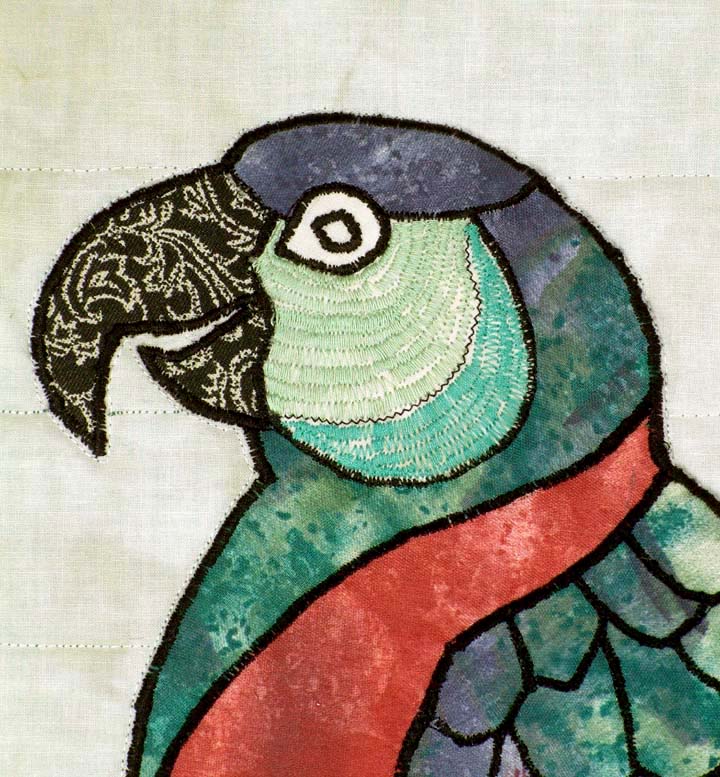
Jungle Parrot. Detail.

Ed was down in the dumps, and having a little trouble coping.  He wanted to hire the Nanny Cay welder, Buck, to work on our boat.  Buck kept telling Ed, “Tomorrow.”  People warned us it would always be “tomorrow” with Buck.  After three days, I finally said, enough.  I called BVI Welders, and they had someone at the yard the next morning.  I also went and yelled at Buck; I felt better afterwards. 

The man from BVI welders worked a long day, doing seven patches.  Then Ed decided to add large steel plates in the stern, just under the transom.  He emptied everything from the cockpit lockers at the stern of the boat, and chipped the rust under the cockpit.  The welders replaced practically the whole area, using two pieces about 3x3 feet each, and a smaller strip between.  Those large plates were much more difficult to weld.  Two welders worked four or five days on that project.  On the last day the welders worked, they were determined to finish.  They took short lunches, and were at it till 6:30 p.m.  The whole area at the stern, about six feet across, from the transom down to the rudder, was replaced.  We had a yard worker do some fairing in, so about all that showed was a seam running down either side of the stern area.

Aside from our new holes in the hull, we also had bubbles in the paint.  I used a metal spatula to open the bubbles.  Ed ground the areas down to bare steel.  We painted on two coats of Rust Lock, a steel primer, and two coats of vinyl undercoat.  We did 15-20% of the hull.  We’d certainly never done such a thorough job before!

I was getting frustrated because there hadn’t been much for me to do.  (Ed watched the welders, and poured water on the hot steel to avoid fires.)  One day I announced to Ed that I was going to sand and paint the aft cabin – an item that had been on my to-do list for months.  Ed wasn’t keen on my making another mess, but I started ripping the aft cabin apart, moving everything out into the saloon, taking down book shelves, and removing doors and drawers.  I sanded and painted everything, including the part of the mizzenmast that stood in the aft cabin, and the inside of the lockers.  It took me six hours.  The next day, I put everything back together.  It came out pretty good, looking fresh and clean.  Some of the paint had been peeling off the walls.

Tuesday, June 13, 2017

1982 (2) – Ed Finishes at Nautool

Mike Masters, Ed's boss at Nautool.
Photo taken at the launch of Dark Horse.

To go to the beginning of this book, Tropic Moon: Memories, click HERE.

Ed worked for Mike Masters at Nautool Machine Ltd. for a little over a year.  It was an incredible opportunity for him to learn machining.  Eventually, Ed was able to do all the machining jobs that came into Nautool, while Mike covered the welding.  Mike sometimes left Ed in charge of the shop – especially after he bought a sailboat to renovate.  After months of working on the boat, Mike launched Dark Horse, and we were present for the celebration.

 It pleased me when I’d hear a comment like I got from a taxi driver.  When I told him where Ed was working, he said, “That your husband?  He’s a good man.” 

Ed took advantage of working in a machine shop, and did extensive stainless steel projects for Tropic Moon.  These included a new bow pulpit, stanchions and lifelines, gateposts, cockpit drains, and a shaft for the gearshift.

Dark Horse, after launch.  Mike is at the wheel.
Tropic Moon is anchored in the background.

When Ed started at Nautool, he was being paid on a piece-by-piece basis.  As he gained proficiency at the work, Mike put Ed on salary.  Towards the end of Ed’s time at Nautool, Mike was billing Ed’s work out at $35/hour.  (Remember, this was 1982.)  Six months before, it had been $25/hour.  At the end of Ed’s first year, Mike raised Ed’s salary by 20%, hoping he’d stay on a second year.  That wasn’t happening!

Once again – for the third year in a row – we planned to leave the Caribbean and sail to the States.  Our window of opportunity was May and June – between winter up north, and the hurricane season starting in July.  But first, we’d have to haul the boat and do some major work on Tropic Moon.  We scheduled a haul out for April 12th.  Ed finished working at Nautool the week before.

Ed ordered new navigation lights, and a new stern light.  We had our life raft serviced, including buying new flares and other safety equipment.  We ordered a new mizzen sail from a local sail maker.

In early April, we had dinner at the Pub, our favorite restaurant in Road Town.  We ran into two couples we knew from Maya Cove.  One couple had been due to leave on April 1st for Maine, so we were surprised to see them.  They explained they’d been out sailing on March 26th.  During a squall, the boat heeled over twice.  The second time, it came back up without the mast!  They don’t know what failed.  They couldn’t get control of the mast in the water.  Worried that it would pierce the fiberglass hull, they had to cut it loose.  Not only did they lose the mast and rigging, but also new sails that had just arrived from England.  As they said, better to have it happen near land, rather than out in the Atlantic.

Needless to say – not what we needed to hear right before our own passage!

Sunday, June 11, 2017

1982 (1) – Hans and Jenny

See Eule

To go to the beginning of this book, Tropic Moon: Memories, click HERE.

Hans and Jenny were from Germany.  See Eule (German for Sea Owl) was their 40-foot Ferro-cement, junk-rigged schooner.  (Junk-rigged means the boat had accordion-pleated sails, like a Chinese junk.)  They built the boat themselves, with the exception of the hull.  They even cut the trees for the masts in a forest in northern Germany.  See Eule was what people refer to as a survival boat.  The cockpit was enclosed, and the sliding hatch had a raised Plexiglas bubble.  Standing in the cockpit, they could survey 360 degrees around the boat.  They could tack the boat, and even raise and lower the sails from within the enclosed cockpit.  In bad weather, they never needed to go out on deck.  See Eule had many nice features.  We both got a kick out of the large chart table, which lifted to reveal Hans’ electric train set, with its miniature cars and track.

Hans and Jenny sailed See Eule in northern Germany.  They took her through France by way of the canal system.  They then spent time in the Mediterranean before crossing the Atlantic.  They were staying in Tortola for a year and a half while Hans worked as Stores Manager for one of the charter boat companies.  Jenny did some skippering on charter boats, and looked after boats for absent owners.  She also took up sewing – play suits, tube dresses, bikinis – getting her customers by word of mouth, and doing quite a good business.

Jenny and Hans

December 16th (1981) was Hans’ 40th birthday, and we were invited over for dinner.  Jenny made German goulash, boiled potatoes, salad, and, for dessert, German chocolate pudding topped with white custard.  Birthdays should be celebrated, so in January, as Ed was turning 37 on the 10th, and Jenny turning 35 on the 11th, I decided to have a small birthday party on Tropic Moon.  We also invited another couple, Susanna and Gerd, who were mutual friends.  I cooked the dinner – quiche, fresh fruit salad, and beer bread.  Gerd and Susanna brought over champagne.  Susanna created the dessert – a butter crème torte, the kind she always made for Gerd’s birthday cake.  She spent hours on it.  The cake stood four layers high, with jam for two of the fillings, and butter crème for the third.  The whole torte was covered with the butter crème frosting.  

In February, Jenny and Hans found out they were pregnant.  They’d been trying for a while, and couldn’t have been happier.  In April, Hans finished his job with the charter boat company.  They hauled See Eule, and began preparing her for passage.  With the baby coming, they were concerned about being in the Virgin Islands for hurricane season.  They decided to get south of the hurricane belt, and have the baby in Curacao, a Dutch island off South America.

I crocheted a baby sweater for the little one.  I think I probably found the only pattern on the island!  It was fairly complicated, with popcorn stitches, ridge stitches, a Peter Pan collar and raglan sleeves.  The only choice in baby yarn was pink or blue.  I picked blue because I knew Jenny hated pink.  Jenny was working on her maternity wardrobe and had two dresses, two pairs of long shorts, and a blouse finished before they were ready to head south.  Her sewing skills came in handy. 

(In case you’re curious, Mira Margarethe was born September 2, 1982, in Curacao.  Mira had her own swinging hammock on See Eule.  While Mira was still a baby, Hans and Jenny sailed See Eule across the Pacific Ocean to New Zealand, where they settled.  Mira is now in her thirties, married, and with a child of her own.  My, how the years do pass…)